
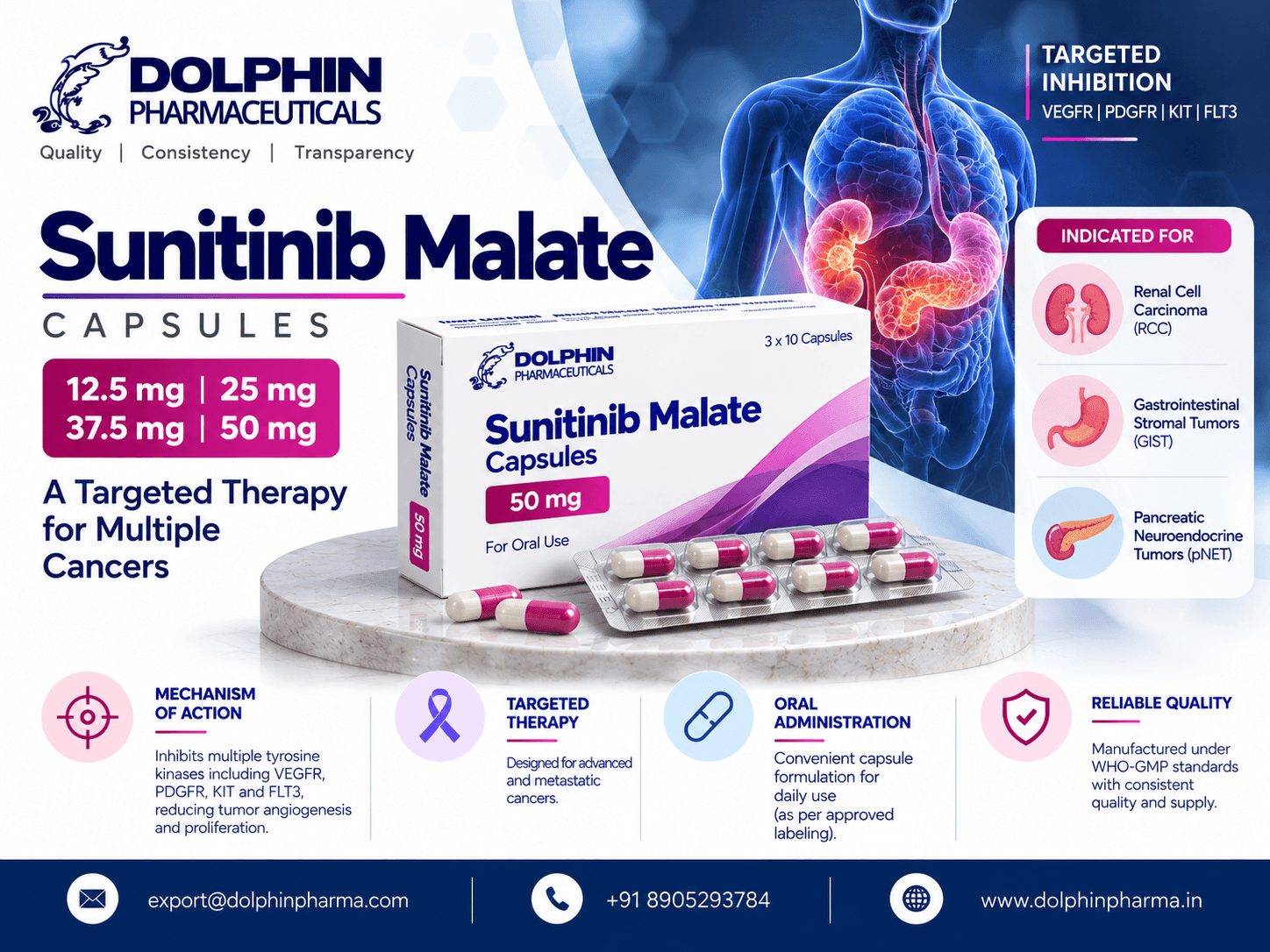
Sunitinib Malate Capsules
Introduction
Access to quality-assured oncology medicines is an important consideration for pharmaceutical importers, distributors, hospital procurement departments, and healthcare institutions. When sourcing specialist medicines internationally, buyers must evaluate product specifications, manufacturer credentials, quality documentation, regulatory requirements, and shipping arrangements before confirming an order.
India has an established pharmaceutical industry supplying finished medicines to international markets. For eligible buyers, Indian pharmaceutical suppliers can provide additional sourcing options, subject to product availability, manufacturing arrangements, and the regulatory requirements of the destination country.
Dolphin Pharmaceuticals, based in Surat, Gujarat, India, offers pharmaceutical products across multiple therapeutic categories. International buyers interested in sunitinib malate capsules can contact the company to enquire about potential sourcing options. The exact product, manufacturer, current availability, documentation, and export eligibility must be confirmed before an order is placed.
This guide explains how global pharmaceutical buyers can evaluate sunitinib suppliers, verify product details, review quality documentation, and plan a responsible pharmaceutical procurement process.
Key Highlights
- Generic name: Sunitinib malate.
- Dosage form: Oral capsules.
- Common strengths: 12.5 mg, 25 mg, 37.5 mg, and 50 mg, depending on the product and market.
- Therapeutic category: Antineoplastic kinase inhibitor.
- Approved uses: Certain gastrointestinal stromal tumours, advanced renal cell carcinoma, and selected pancreatic neuroendocrine tumours, according to applicable product approvals.
- Potential buyers: Authorised pharmaceutical importers, wholesalers, distributors, hospitals, and eligible institutional procurement organisations.
- Important procurement checks: Manufacturer identity, strength, product documentation, batch information, shelf life, storage conditions, and destination-market authorisation.
- Supplier enquiry: Contact Dolphin Pharmaceuticals to confirm whether the required formulation can be sourced for your intended market.
Product strengths, indications, and storage conditions should always be checked against the exact manufacturer's approved product information.
Understanding Sunitinib Malate Capsules
Sunitinib is an oral kinase inhibitor used in the treatment of certain cancers. It acts on specific signalling pathways involved in tumour growth and the formation of blood vessels that support tumour development.
Depending on the applicable product approval, sunitinib may be indicated for:
- Gastrointestinal stromal tumour (GIST) following disease progression on or intolerance to imatinib.
- Advanced renal cell carcinoma (RCC).
- Unresectable or metastatic, well-differentiated pancreatic neuroendocrine tumours in eligible patients.
Approved indications can differ by jurisdiction and product label. Buyers should verify the current prescribing information for the exact product and destination market rather than relying solely on a general therapeutic description.
Sunitinib malate is available in oral capsule presentations, including commonly referenced strengths of 12.5 mg, 25 mg, 37.5 mg, and 50 mg. The appropriate strength and regimen depend on the prescribed treatment plan and the patient's clinical circumstances.
For pharmaceutical procurement teams, exact product identification is essential. The requested medicine should be verified by its generic name, strength, dosage form, manufacturer, packaging, and applicable regulatory status.
Sunitinib is a prescription oncology medicine. Treatment selection, dosing, and monitoring must be managed by qualified healthcare professionals.
Sunitinib Malate Capsules: Product Details
The following information can help international buyers prepare a product-specific procurement enquiry.
- Generic name: Sunitinib malate.
- Dosage form: Oral capsules.
- Common strengths: 12.5 mg, 25 mg, 37.5 mg, and 50 mg, subject to product availability and market approval.
- Therapeutic category: Antineoplastic kinase inhibitor.
- Therapeutic use: Selected cancers according to the applicable approved product information.
- Route of administration: Oral.
- Brand preference: Specify the required brand, if applicable.
- Manufacturer: Confirm the actual manufacturer and manufacturing site.
- Packaging: Verify available pack sizes and packaging configurations.
- Storage: Follow the approved label for the exact product. Some capsule presentations specify controlled room-temperature storage, typically 20–25°C, with permitted excursions according to the applicable label.
- Shelf life: Confirm the batch expiry date and minimum remaining shelf life required by the importer.
- Availability: Must be confirmed directly with the supplier.
- Export eligibility: Depends on the product, manufacturer, and destination-market requirements.
These details are intended for procurement planning and do not confirm that a particular sunitinib product or strength is currently available from Dolphin Pharmaceuticals.
Why Consider a Sunitinib Supplier from India?
International buyers may evaluate Indian pharmaceutical suppliers as part of their sourcing strategy. However, supplier selection should be based on verifiable product information, business credentials, documentation, and regulatory compliance rather than price or country of origin alone.
1. Pharmaceutical Sourcing Options
Indian pharmaceutical suppliers operate across a wide range of therapeutic categories. Depending on their product portfolios and sourcing arrangements, they may be able to review enquiries for specific oncology medicines.
Buyers should provide the required strength, brand preference, dosage form, packaging, quantity, and destination country to help the supplier assess the request.
2. Manufacturer Transparency
The exporter and the actual medicine manufacturer may be different organisations. Buyers should establish which company manufactures the product and identify the manufacturing site where relevant.
Manufacturer details should be consistent with the product label and supporting documentation. Where required, buyers should verify the applicable manufacturing and distribution authorisations.
3. Quality Documentation
Quality assurance is an important part of oncology medicine procurement. Buyers should request documentation relevant to the exact product and batch.
Depending on the transaction and applicable regulations, this may include product specifications, batch information, a Certificate of Analysis, manufacturing details, and relevant quality certificates.
Documents should be checked for completeness and consistency before a shipment is approved.
4. International Procurement Coordination
Cross-border pharmaceutical sourcing requires coordination among the supplier, exporter, importer, logistics provider, and regulatory authorities.
Buyers should discuss product availability, quotation validity, payment terms, minimum order quantities where applicable, packaging, delivery estimates, and documentation responsibilities before finalising an order.
Clear written terms help reduce uncertainty and support a more organised procurement process.
Dolphin Pharmaceuticals: Pharmaceutical Sourcing Enquiries
Dolphin Pharmaceuticals is based in Surat, Gujarat, India, and offers pharmaceutical products across multiple therapeutic categories.
For buyers seeking a sunitinib malate capsules exporter from India, the company can be contacted to discuss the specific product requirement.
Before proceeding, buyers should request confirmation of:
- Whether the required sunitinib product can be sourced.
- The available strength and dosage form.
- Brand name, if applicable.
- Actual manufacturer and manufacturing site.
- Current availability and quotation.
- Packaging configuration and minimum order quantity, where applicable.
- Relevant product and batch documentation.
- Storage and transportation requirements.
- Export eligibility for the intended destination.
- Estimated lead time and shipping arrangements.
A supplier's general pharmaceutical portfolio does not establish that a particular medicine is currently stocked or approved for export to every market. Product-specific information should be confirmed directly before an order is finalised.
How to Evaluate a Reliable Sunitinib Exporter
Selecting an oncology medicine exporter requires a structured assessment of the supplier, product, and proposed transaction.
Verify Supplier Credentials
Review the supplier's business identity, relevant licences, and role in the pharmaceutical supply chain. Establish whether the company manufactures the medicine, distributes it, or exports a product manufactured by another organisation.
Verify the relevant authorisations for the manufacturer, exporter, and importing organisation where required.
Confirm the Exact Product Specification
Check the generic name, strength, dosage form, brand preference, packaging, and manufacturer.
Sunitinib is available in different strengths. The proposed product should match the buyer's exact specification, and any substitution should undergo appropriate approval and regulatory review.
Review Product and Batch Documentation
Request the documentation applicable to the medicine being offered. Verify that the product name, strength, manufacturer, batch number, expiry information, and other relevant details are consistent across the records.
Resolve missing information or discrepancies before approving the shipment.
Assess Storage and Transportation
Review the approved storage instructions for the exact product. Some sunitinib capsule labels specify controlled room-temperature storage, but the applicable product label should determine the conditions for the supplied medicine.
Buyers should also confirm packaging integrity, transit arrangements, expected delivery time, and the remaining shelf life upon arrival.
Compare Complete Quotations
Compare quotations using the same product specifications and commercial terms.
Consider the unit price, quantity, packaging, remaining shelf life, documentation, freight, insurance where applicable, payment conditions, and expected delivery timeline.
A low price alone does not demonstrate product authenticity, quality, or regulatory eligibility.
Quality Documentation for Sunitinib Procurement
The documents required for an international sunitinib transaction depend on the product, manufacturer, importing arrangement, and destination-country regulations.
Commercial Documents
Common commercial records may include:
- Proforma invoice.
- Commercial invoice.
- Packing list.
- Purchase order and agreed sales terms.
- Applicable transport documentation.
Product and Quality Documents
Depending on the transaction, buyers may need:
- Product specifications and approved product information.
- Manufacturer and manufacturing-site details.
- Batch number and expiry information.
- Certificate of Analysis, where applicable.
- Relevant manufacturing or quality certificates.
- Product registration or approval documents, where required.
Regulatory Documents
Buyers should determine whether product registration, an import permit, importer authorisation, or other regulatory approval is required.
Institutional or public-sector procurement may involve additional supplier qualification or product quality-assurance requirements.
Not every document applies to every transaction. Buyers should confirm the exact requirements with the relevant authorities and supply-chain partners before shipment.
Regulatory Compliance for Global Pharmaceutical Supply
Pharmaceutical exports and imports are governed by the laws and procedures of the relevant countries. A medicine available in India is not automatically approved for import or sale in another market.
Before confirming an order, buyers should verify:
- Whether the specific product is registered or otherwise authorised in the destination country.
- Whether an import permit or additional approval is required.
- Whether the importing organisation is authorised to receive and distribute the medicine.
- Which product, manufacturer, and quality documents must be submitted.
- Whether packaging and labelling meet local requirements.
- Whether the transaction is subject to additional restrictions or procurement conditions.
Where a procurement programme requires a specific quality-assurance standard or product listing, buyers should verify the exact medicine, formulation, manufacturer, and manufacturing site. Approval or prequalification of one product should not be assumed to apply to another product from the same company.
Regulatory checks should be completed before finalising the purchase or dispatching the shipment.
Storage, Packaging, and International Shipping
Appropriate storage and shipping arrangements help maintain product quality throughout the supply chain.
Storage Requirements
Follow the approved product label for the exact sunitinib capsule being supplied. Some presentations specify storage at controlled room temperature, commonly 20–25°C, with defined permitted excursions.
Buyers should not assume that all brands and packaging presentations have identical requirements.
Packaging and Labelling
Confirm the available pack size and ensure that the packaging and labelling meet the destination market's requirements.
The product name, strength, manufacturer, batch information, and expiry details should be consistent with the supporting documentation.
Shelf-Life Management
Confirm the batch expiry date and minimum remaining shelf life required by the importer.
Allow sufficient time for international transportation, customs clearance, and local distribution when planning an order.
Shipment Coordination
Agree on the shipping method, estimated dispatch date, transit time, documentation responsibilities, and any special handling conditions before dispatch.
The supplier, importer, and logistics provider should coordinate to ensure that the product is handled according to its documented requirements.
How to Request a Quotation from Dolphin Pharmaceuticals
A clear product enquiry helps the supplier assess whether a suitable sourcing option may be available.
International buyers should provide:
- Required sunitinib strength.
- Preferred brand or manufacturer, if applicable.
- Dosage form and pack size.
- Required quantity.
- Destination country.
- Known registration or import requirements.
- Required product and quality documents.
- Preferred delivery schedule.
Buyers should request written confirmation of the exact product specifications, manufacturer, availability, commercial terms, supporting documents, and export eligibility.
The quotation should identify the product being offered clearly so that it can be checked against the original procurement requirement.
Frequently Asked Questions
1. What is sunitinib malate used for?
Sunitinib is used for certain cancers, including selected cases of gastrointestinal stromal tumour, advanced renal cell carcinoma, and pancreatic neuroendocrine tumours, according to the applicable product approval.
2. What strengths of sunitinib capsules are commonly available?
Commonly referenced strengths include 12.5 mg, 25 mg, 37.5 mg, and 50 mg. Buyers should verify the exact strength and formulation required for their market.
3. Can sunitinib malate capsules be exported from India?
International supply may be possible when the product, exporter, importer, and transaction meet applicable requirements. Product availability and export eligibility must be confirmed for the specific product and destination.
4. Does Dolphin Pharmaceuticals currently stock sunitinib?
Current stock and sourcing availability must be confirmed directly with Dolphin Pharmaceuticals. Buyers should provide the required strength, quantity, preferred manufacturer, and destination country.
5. Which documents should buyers request?
Depending on the product and destination, relevant documents may include product specifications, manufacturer details, batch information, a Certificate of Analysis where applicable, quality certificates, and required registration or import documents.
6. How should sunitinib capsules be stored?
Storage must follow the approved label for the exact product supplied. Some presentations specify controlled room-temperature storage with permitted excursions.
7. Can sunitinib be exported to every international market?
No. Registration, import permissions, importer authorisation, and procurement requirements vary by country. Buyers should verify the applicable requirements before confirming an order.
Conclusion
Finding a dependable sunitinib malate capsules exporter from India requires careful evaluation of product specifications, manufacturer credentials, quality documentation, regulatory compliance, and international logistics.
Dolphin Pharmaceuticals, based in Surat, Gujarat, India, can be contacted to discuss potential sourcing requirements for sunitinib malate capsules. Buyers should confirm the exact strength, formulation, manufacturer, current availability, supporting documentation, commercial terms, and destination-market eligibility before finalising an order.
For pharmaceutical importers, wholesalers, distributors, and institutional procurement teams, a clear product specification and documented supplier review can support a more transparent and organised procurement process.
Planning a sunitinib procurement enquiry? Prepare the required strength, quantity, preferred manufacturer, destination country, and documentation requirements so that Dolphin Pharmaceuticals can assess the request and clarify potential next steps.
Disclaimer: This article is intended for pharmaceutical procurement and general informational purposes only. Sunitinib is a prescription oncology medicine and must be prescribed and monitored by qualified healthcare professionals. Products should be sourced and distributed through authorised pharmaceutical channels.
My Company Name - Dolphin Pharmaceuticals
My Website - https://www.dolphinpharma.in/