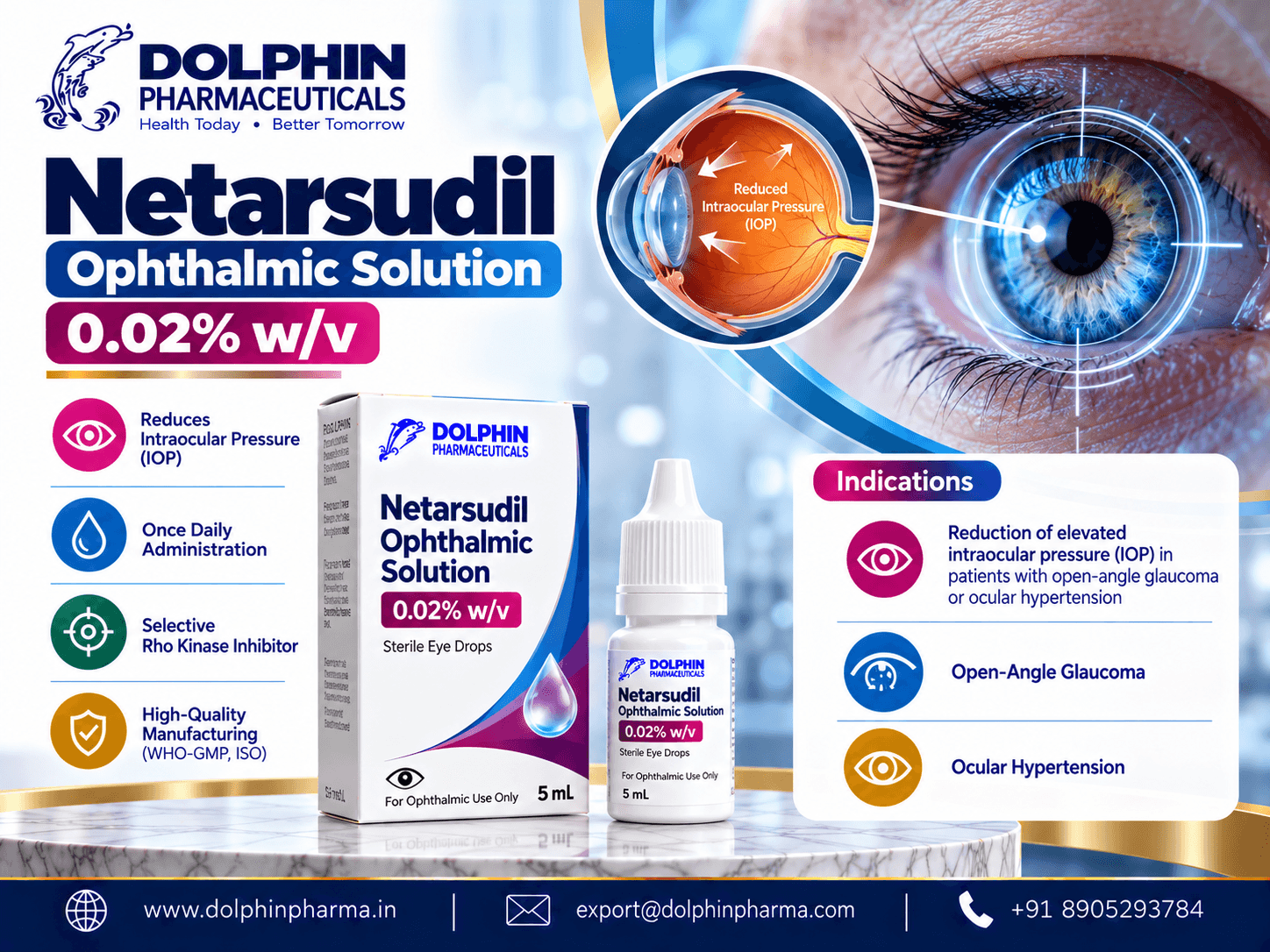
Netarsudil Opthalmic Solution 0.02% w/v
Introduction
The global ophthalmic pharmaceutical market serves hospitals, eye clinics, pharmacies, pharmaceutical distributors, and healthcare procurement organizations that require reliable access to quality-assured eye medicines. For international buyers, selecting an appropriate ophthalmic medicine exporter involves more than comparing prices. Product specifications, manufacturer credentials, quality documentation, regulatory requirements, storage conditions, and shipping arrangements all play important roles in the procurement process.
Netarsudil ophthalmic solution is a prescription eye medicine used to reduce elevated intraocular pressure in patients with open-angle glaucoma or ocular hypertension. The medicine belongs to a class known as Rho kinase inhibitors and is used under the supervision of qualified healthcare professionals.
India has an established pharmaceutical manufacturing and export sector, including companies involved in ophthalmic products. Dolphin Pharmaceuticals, based in Surat, Gujarat, India, provides a pharmaceutical sourcing and export enquiry channel for international buyers. Organizations interested in netarsudil ophthalmic solution should contact the company to confirm whether the specific product can be supplied or sourced and whether the proposed shipment meets the destination country's requirements.
This guide explains the product's key characteristics, how to evaluate a netarsudil ophthalmic solution exporter from India, which documents buyers may need, and what to consider before arranging an international pharmaceutical shipment.
Key Highlights
- Generic name: Netarsudil.
- Commonly referenced strength: 0.02% ophthalmic solution, equivalent to 0.2 mg/mL.
- Dosage form: Sterile ophthalmic solution.
- Therapeutic category: Ophthalmic medicine; Rho kinase inhibitor.
- Established indication: Reduction of elevated intraocular pressure in open-angle glaucoma or ocular hypertension, according to applicable product labeling.
- Buyer priorities: Product authenticity, manufacturer verification, quality documentation, regulatory compliance, and suitable shipping conditions.
- Supplier verification: Current availability, manufacturer, pack size, commercial terms, and export eligibility must be confirmed directly.
- Company enquiry: International pharmaceutical buyers can contact Dolphin Pharmaceuticals regarding specific product requirements.
Understanding Netarsudil Ophthalmic Solution
Netarsudil is an ophthalmic medicine used to reduce elevated intraocular pressure. It works as a Rho kinase inhibitor and affects mechanisms involved in the regulation of pressure inside the eye.
Elevated intraocular pressure is associated with certain eye conditions, including open-angle glaucoma and ocular hypertension. Appropriate treatment depends on an ophthalmologist's assessment and the patient's individual circumstances.
For pharmaceutical procurement teams, understanding the medicine's identity and formulation helps prevent confusion between different ophthalmic products.
Product Details
- Generic name: Netarsudil.
- Active ingredient: Netarsudil, commonly formulated as netarsudil mesylate equivalent to netarsudil.
- Common strength: 0.02% w/v, equivalent to 0.2 mg/mL.
- Dosage form: Ophthalmic solution.
- Route of administration: Topical ophthalmic use.
- Therapeutic category: Ophthalmology.
- Pharmacological class: Rho kinase inhibitor.
- Commonly referenced indication: Reduction of elevated intraocular pressure in patients with open-angle glaucoma or ocular hypertension.
- Packaging: Bottle size, fill volume, closure, and pack configuration depend on the specific manufacturer's product.
- Storage: Follow the exact product label and manufacturer's approved instructions.
- Availability: Must be confirmed with the supplier for the required market and quantity.
These details describe a commonly referenced netarsudil 0.02% formulation. Buyers should verify the exact product specifications, approved labeling, manufacturer, and presentation before ordering.
Why Product Verification Matters for Ophthalmic Medicines
Ophthalmic solutions require particular attention to product quality because they are applied directly to the eye. Product identity, sterility, formulation, packaging integrity, and appropriate handling are important elements of responsible pharmaceutical procurement.
When evaluating a netarsudil ophthalmic solution supplier, buyers should consider the following factors.
1. Correct Product Identification
Confirm the generic name, strength, dosage form, and intended product presentation.
Buyers should distinguish between netarsudil ophthalmic solution and combination products containing netarsudil with another active ingredient. Combination products have different specifications and should not be treated as interchangeable with netarsudil-only formulations.
2. Manufacturer Transparency
Identify the actual manufacturer and manufacturing site. An exporter or supplier may distribute products manufactured by another pharmaceutical company rather than manufacture every product in its catalogue.
Manufacturer information should match the product label and supporting documentation.
3. Sterility and Packaging Integrity
Sterility is a critical quality attribute for ophthalmic solutions. Buyers should request appropriate product and batch documentation and verify that the proposed packaging is suitable for the medicine.
Packaging should remain intact during storage, handling, and transportation. Any evidence of damage, leakage, or compromised packaging should be addressed according to the applicable quality procedures.
4. Product-Specific Documentation
Request documentation relevant to the exact product and destination market. Depending on the transaction, this may include product specifications, batch details, a Certificate of Analysis, manufacturing information, and applicable regulatory documents.
Documentation should be consistent with the product being supplied.
Dolphin Pharmaceuticals: Pharmaceutical Sourcing from India
Dolphin Pharmaceuticals is based in Surat, Gujarat, India, and serves as a contact point for international pharmaceutical sourcing enquiries.
For buyers searching for a netarsudil ophthalmic solution exporter from India, the company can be approached to determine whether the required medicine is available through its current supply arrangements.
Product-specific verification is essential. A general ophthalmology or pharmaceutical portfolio does not establish that netarsudil is currently available, that the company manufactures it, or that the product is authorized for export to every country.
Before proceeding, buyers should request confirmation of:
- Current product availability.
- Generic name and strength.
- Whether the product contains netarsudil alone or a combination of active ingredients.
- Actual manufacturer and manufacturing site.
- Bottle size and packaging configuration.
- Minimum order quantity, if applicable.
- Batch-specific quality documentation.
- Remaining shelf life.
- Storage and transportation requirements.
- Export eligibility and destination-market requirements.
- Quotation, lead time, and shipping arrangements.
This information allows procurement teams to assess whether a proposed supply arrangement meets their requirements.
How to Choose a Reliable Netarsudil Ophthalmic Solution Exporter
Choosing a pharmaceutical exporter requires a structured evaluation process. International buyers should review the supplier's business credentials, product information, documentation, and ability to coordinate a compliant shipment.
Verify the Supplier's Business Credentials
Review the supplier's legal business details, relevant licences, and role in the pharmaceutical supply chain. Establish whether the company acts as a manufacturer, exporter, distributor, or sourcing intermediary.
Where required, verify the relevant authorizations for the manufacturer, exporter, and importer.
Confirm the Exact Product Specification
A quotation request should clearly state:
- Generic name: netarsudil.
- Required strength: for example, 0.02% w/v, if that is the requested formulation.
- Dosage form: ophthalmic solution.
- Product type: single-ingredient or combination formulation.
- Preferred manufacturer, where applicable.
- Required pack size.
- Order quantity.
- Destination country.
- Documentation requirements.
Providing precise specifications helps prevent product mismatches and makes supplier quotations easier to compare.
Review Quality Documentation
Ask for documentation appropriate to the medicine and transaction. Buyers may need product specifications, batch information, a Certificate of Analysis, manufacturing details, and applicable quality certificates.
For ophthalmic solutions, confirm that the documents address the product being offered and that the relevant quality requirements for sterile ophthalmic preparations are met.
Evaluate Commercial Terms
Review the quotation, payment terms, minimum order quantity, quotation validity, lead time, packaging, and shipping conditions.
Buyers should also establish whether the product is available for immediate supply or requires additional sourcing and verification.
Assess Communication and Supply Planning
Clear communication helps buyers coordinate procurement approvals, documentation reviews, shipment planning, and future orders.
For recurring requirements, discuss expected order volumes, lead times, product shelf life, and the supplier's ability to provide reliable updates.
Storage and Transportation Considerations
Netarsudil ophthalmic solution must be stored and transported according to the approved product labeling. Storage conditions can vary by product and may differ before and after opening.
For example, the U.S. prescribing information for one marketed netarsudil 0.02% product specifies refrigeration before opening and permits different storage conditions after opening. These instructions should not automatically be applied to another manufacturer's formulation or export presentation.
Before shipment, buyers should confirm:
- The manufacturer's approved storage temperature.
- Any protection-from-light requirements.
- Permitted shipping temperature excursions, if specified.
- Packaging and closure requirements.
- Shelf life at dispatch and expected shelf life on arrival.
- Any temperature-monitoring requirements.
- Procedures for managing damaged or temperature-exposed shipments.
The exporter, logistics provider, and importer should agree on suitable transportation arrangements before dispatch. The product's own approved labeling and shipping requirements must take precedence over general assumptions about ophthalmic medicines.
Pharmaceutical Export and Import Compliance
Pharmaceutical export requirements depend on the product, manufacturer, exporter, importing organization, and destination country.
India's pharmaceutical regulatory framework includes requirements relevant to the manufacture and export of medicines, including specific good manufacturing practice provisions for sterile ophthalmic preparations.
International buyers must also verify the rules that apply in their own market. A product that can be supplied in one country is not automatically authorized for import, distribution, or sale in another.
Before confirming an order, buyers should establish:
- Whether the medicine is registered or otherwise authorized in the destination market.
- Whether an import permit or other authorization is required.
- Whether the importing organization holds the necessary licences.
- Which manufacturer and product documents must be submitted.
- Whether product labeling and packaging comply with local rules.
- Whether additional requirements apply to sterile ophthalmic preparations.
- Which export, shipping, and customs documents are required.
Regulatory checks should be completed before dispatch. Buyers should obtain current, product-specific guidance from the relevant authorities and their authorized regulatory or import partners.
Documents International Buyers May Need
The precise documentation package depends on the product and destination market. Buyers should agree on a document checklist before confirming an order.
Product and Quality Documents
- Product specification.
- Manufacturer and manufacturing-site details.
- Batch number and expiry information.
- Certificate of Analysis, where applicable.
- Relevant manufacturing or quality certificates.
- Product labeling and packaging details.
- Storage and handling instructions.
Commercial Documents
- Proforma invoice.
- Commercial invoice.
- Packing list.
- Purchase order and agreed commercial terms.
- Applicable shipping documents.
Regulatory Documents
- Product registration or approval documents, where required.
- Import permit or other applicable authorization.
- Certificates required by the relevant authorities.
- Supporting documents needed for customs clearance.
Not every document applies to every transaction. The importer should confirm the exact requirements with the relevant authorities and supply-chain partners.
Common Challenges in Ophthalmic Medicine Procurement
International pharmaceutical buyers may encounter challenges when sourcing ophthalmic medicines across borders. Planning ahead can help reduce avoidable problems.
Product Availability
A medicine listed in a supplier's catalogue may not be immediately available. Buyers should request written confirmation of current availability and expected lead time.
Manufacturer and Brand Differences
Different manufacturers may offer different presentations, packaging, and approved product information. Buyers should compare the exact specifications rather than relying on the generic name alone.
Storage During Transit
Temperature excursions or unsuitable handling can create product-quality concerns. Confirm the manufacturer's requirements and ensure the proposed shipping plan is appropriate.
Regulatory Delays
Missing documents or incomplete import approvals can delay shipments. The exporter and importer should identify the required documentation before the order is finalized.
Remaining Shelf Life
International transit and customs clearance can reduce the usable shelf life remaining when the product arrives. Buyers should agree on minimum shelf-life requirements before shipment.
How to Request a Quotation from Dolphin Pharmaceuticals
International pharmaceutical buyers can prepare a detailed product enquiry to help the supplier assess their requirements.
Include the following information:
- Product: Netarsudil ophthalmic solution.
- Strength: Required strength, such as 0.02% w/v, if applicable.
- Formulation: Single-ingredient or combination product.
- Packaging: Required bottle size and pack configuration.
- Quantity: Expected order volume.
- Destination: Country of import.
- Manufacturer preference: If applicable.
- Documentation: Any specific quality or regulatory documents required.
- Delivery expectations: Preferred shipment timeline and relevant handling requirements.
Ask Dolphin Pharmaceuticals to confirm whether the exact product can be supplied or sourced, who manufactures it, which documents are available, and whether export to the destination market is possible.
All commercial terms, product specifications, and regulatory requirements should be verified before the order is confirmed.
Frequently Asked Questions
1. What is netarsudil ophthalmic solution used for?
Netarsudil ophthalmic solution is used to reduce elevated intraocular pressure in patients with open-angle glaucoma or ocular hypertension, according to the applicable product labeling. Treatment should be directed by a qualified eye-care professional.
2. What is the commonly referenced strength of netarsudil ophthalmic solution?
A commonly referenced formulation is 0.02% w/v, equivalent to 0.2 mg/mL. Buyers should verify the exact strength and presentation of the product they intend to source.
3. Is Dolphin Pharmaceuticals a manufacturer of netarsudil ophthalmic solution?
This should not be assumed without product-specific confirmation. Buyers should ask the company to identify the actual manufacturer and clarify whether it manufactures, distributes, or sources the product.
4. Can netarsudil ophthalmic solution be exported from India to any country?
Export and import eligibility depend on the product, the applicable Indian requirements, and the destination country's regulations. Buyers must verify the necessary approvals and documentation before shipment.
5. What documents should buyers request?
Depending on the transaction, buyers may need product specifications, manufacturer details, batch documentation, a Certificate of Analysis, applicable quality certificates, commercial invoices, packing lists, and regulatory permits.
6. Does netarsudil ophthalmic solution require refrigeration?
Storage requirements depend on the specific product and its approved labeling. Buyers should obtain the manufacturer's current instructions and confirm suitable transportation conditions before shipment.
7. What should buyers check before accepting a shipment?
Check product identity, strength, manufacturer, packaging integrity, batch and expiry details, required documentation, storage history where relevant, and compliance with destination-market requirements.
Conclusion
Selecting a dependable netarsudil ophthalmic solution exporter from India requires careful attention to product specifications, manufacturer transparency, sterile product quality, documentation, storage conditions, and regulatory compliance.
Dolphin Pharmaceuticals, based in Surat, Gujarat, India, can be contacted by international pharmaceutical buyers to discuss specific sourcing requirements. The availability, manufacturer, pack size, supporting documentation, and export eligibility of netarsudil ophthalmic solution must be confirmed directly before an order is placed.
For pharmaceutical distributors, licensed importers, hospitals, and other authorized buyers, the most effective approach is to provide a precise product specification, review the supplier's documentation, verify destination-market requirements, and agree on suitable transportation conditions before shipment.
Contact Dolphin Pharmaceuticals with your required strength, pack size, quantity, and destination country to enquire about potential supply options and product-specific export requirements.
Disclaimer: This article is intended for pharmaceutical procurement and general informational purposes only. It does not provide medical advice or guarantee product availability, manufacturing status, regulatory approval, or export eligibility. Netarsudil should be used under appropriate professional supervision.
My Company Name - Dolphin Pharmaceuticals
My Website - https://www.dolphinpharma.in/