
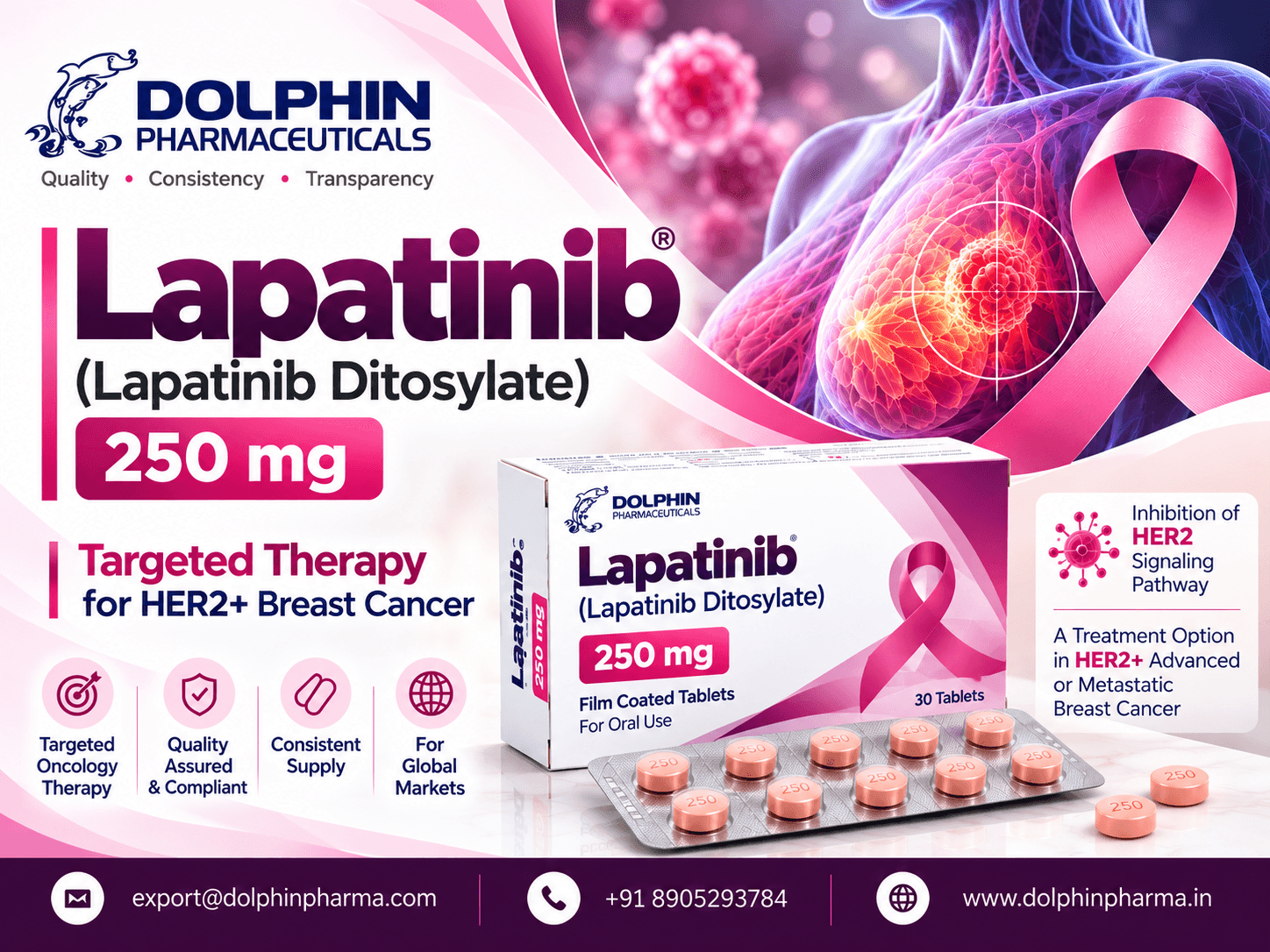
Lapatinib 250mg
Introduction
Choosing a reliable pharmaceutical supplier is an important decision for international buyers sourcing oncology medicines. Product quality, manufacturer transparency, regulatory documentation, supply consistency, and export capability all play a role in establishing a dependable pharmaceutical supply chain.
For pharmaceutical importers, wholesalers, distributors, and authorised healthcare procurement organisations, finding a Lapatinib 250 mg supplier and exporter from India requires careful evaluation beyond price comparisons. Buyers need to ensure that the product matches their specifications and that the proposed supply arrangement complies with the requirements of the destination country.
Dolphin Pharmaceuticals, based in Surat, Gujarat, India, offers a pharmaceutical portfolio that includes anti-cancer and oncology products. International buyers can contact the company to enquire about specific product requirements, subject to availability, manufacturer arrangements, and applicable export regulations.
This guide explains how to evaluate a potential Lapatinib 250 mg supplier, what product information to request, which quality documents to review, and how to approach international procurement responsibly.
Key Highlights
- Verify the exact Lapatinib 250 mg product and its manufacturer.
- Confirm current availability, packaging, and minimum order requirements.
- Request appropriate product and batch-specific quality documentation.
- Review the supplier's export experience and commercial transparency.
- Check destination-country registration and import requirements before ordering.
- Confirm product storage conditions and transportation arrangements.
- Compare total procurement costs rather than unit price alone.
- Establish written terms for delivery, documentation, and ongoing supply.
What Is Lapatinib 250 mg?
Lapatinib is an oral targeted anti-cancer medicine used in specific treatment settings for certain types of breast cancer under the supervision of qualified healthcare professionals. Its use depends on the approved indication, the patient's clinical circumstances, and the treatment plan established by the treating specialist.
Lapatinib 250 mg tablets are a recognised pharmaceutical presentation. However, international buyers should verify the precise product being offered, including its active ingredient, formulation, manufacturer, brand name where applicable, and approved product information.
For procurement purposes, the following details should be confirmed before a quotation is accepted:
- Product name: Lapatinib 250 mg tablets.
- Active ingredient: Lapatinib; confirm the precise salt form and how the strength is expressed on the product label.
- Strength: 250 mg, as stated in the approved product documentation.
- Dosage form: Oral tablet, subject to confirmation against the offered product.
- Brand name: Confirm whether a branded or generic product is being offered.
- Manufacturer: Identify the actual manufacturing company.
- Pack size: Confirm the number of tablets and packaging configuration.
- Shelf life: Verify the manufacturing date, expiry date, and remaining shelf life.
- Storage requirements: Follow the product-specific label and manufacturer's instructions.
- Regulatory status: Confirm eligibility for the intended destination market.
These details help prevent confusion between products and ensure that the buyer evaluates the correct medicine.
Why Supplier Selection Matters for Lapatinib 250 mg
Oncology medicines require careful procurement because product identity, quality, documentation, and regulatory status are important considerations throughout the supply chain.
A suitable supplier should provide clear information about the product and its source. Buyers should be able to understand whether the company manufactures the medicine directly, purchases it from a manufacturer, or operates as an exporter or distributor.
1. Product Authenticity and Traceability
Product authenticity should be a priority when evaluating any oncology medicine supplier.
Buyers should request documentation that allows them to verify the product, manufacturer, batch details, and expiry information. The documents should correspond to the exact product being quoted and supplied.
Traceability also helps procurement teams investigate discrepancies and manage quality-related concerns if they arise.
2. Manufacturer Transparency
The supplier should identify the actual manufacturer of the proposed Lapatinib 250 mg product.
An exporter and a manufacturer are not necessarily the same organisation. Understanding their respective roles helps buyers evaluate the supply chain, request the appropriate documents, and establish accountability.
Do not assume that a supplier manufactures a product simply because it appears in its catalogue.
3. Consistent Commercial Communication
A reliable business relationship depends on clear communication about product availability, quotation validity, order quantities, expected dispatch, and delivery arrangements.
Buyers should obtain written confirmation of the agreed specifications and commercial terms before proceeding with a purchase.
4. Regulatory Awareness
The supplier and importing organisation should understand their respective responsibilities for pharmaceutical exports and imports.
The buyer must establish whether the medicine is registered, approved, or otherwise eligible for importation under the rules of the destination country. Any required permits or authorisations should be confirmed before shipment.
How to Evaluate a Lapatinib 250 mg Supplier from India
International pharmaceutical buyers can use the following steps to assess a potential supplier.
Step 1: Confirm Product Availability
Begin by sharing the exact product requirement with the supplier.
Specify the generic name, strength, dosage form, preferred brand if applicable, packaging requirements, quantity, and destination country.
Ask the supplier to confirm whether the requested product can be supplied. A website listing alone should not be treated as confirmation of current stock or export availability.
Step 2: Verify the Actual Manufacturer
Request the name and relevant details of the manufacturing company.
Check that the manufacturer information is consistent across the quotation, product documentation, packaging details, and other relevant records.
If the exporter sources the medicine from a third party, clarify the supply arrangement and determine which party is responsible for providing the required product documentation.
Step 3: Review Quality Documentation
Ask which documents are available for the specific product and batch.
Depending on the product and transaction, relevant records may include:
- Product specifications.
- Certificate of analysis, where applicable.
- Batch number and expiry details.
- Manufacturing and licensing information.
- Product label and packaging details.
- Applicable quality certificates or regulatory records.
- Documents required by the importing country.
Document requirements vary by product and market. Buyers should verify the authenticity, relevance, and validity of the documents rather than relying only on general assurances.
Step 4: Check Export Capability
Confirm whether the supplier can support the proposed international transaction and provide the documents required for export.
Buyers should clarify the proposed shipping method, dispatch arrangements, commercial invoice, packing list, and any additional documentation needed for the destination market.
The responsibilities of the exporter, importer, customs broker, and logistics provider should be agreed in advance.
Step 5: Assess Supply Reliability
For recurring orders, buyers should discuss expected lead times, order quantities, stock availability, and the supplier's process for communicating potential delays.
Any forecast of future availability should be treated as provisional until confirmed by the supplier.
A written procurement arrangement can help both parties manage expectations and reduce avoidable misunderstandings.
Essential Documents to Request Before Ordering
The documentation required for Lapatinib 250 mg depends on the product, manufacturer, importing country, and transaction structure.
Before finalising an order, buyers should identify which documents are necessary and confirm that the supplier can provide them.
Product and Manufacturer Documents
- Product specifications: Details identifying the medicine and its pharmaceutical presentation.
- Manufacturer information: The actual manufacturer's name and relevant licensing details.
- Product labelling: Information showing the product name, strength, batch details, expiry information, and other required particulars.
- Quality documentation: Applicable records supporting the quality of the product and, where relevant, the specific batch.
- Regulatory documents: Documents required to establish the product's eligibility for the intended market.
Commercial and Shipping Documents
- Quotation or pro forma invoice: Product details, quantity, pricing, and commercial terms.
- Commercial invoice: The agreed transaction details for the shipment.
- Packing list: Information about the shipment's packaging and contents.
- Shipping documentation: Documents appropriate to the selected transport method.
- Import approvals: Any permits or authorisations required by the destination country.
Not every document applies to every shipment. The buyer should establish a product-specific checklist with the supplier and relevant regulatory or logistics professionals before dispatch.
Understanding Pharmaceutical Export Requirements in India
Pharmaceutical exports from India must comply with applicable Indian laws and regulatory requirements, together with the requirements of the destination country.
The relevant requirements can depend on the medicine, its regulatory classification, the manufacturing and export arrangements, and the intended market. Certain products may require specific permissions or regulatory procedures before they can be manufactured or exported.
For this reason, buyers should ask the supplier to confirm that the proposed product and transaction can proceed through the applicable export process.
Important checks include:
- Manufacturing authorisation: Verify relevant authorisations for the actual manufacturer and product.
- Export documentation: Confirm which documents are required for the particular shipment.
- Product labelling: Check that the proposed labelling meets applicable Indian export rules and destination-country requirements.
- Destination-market compliance: Confirm that the medicine can be legally imported and distributed in the receiving country.
- Special permissions: Determine whether any product-specific permission or approval is applicable.
The buyer should not assume that a product's availability in India automatically permits its export to every market.
Destination-Country Registration and Import Compliance
Import requirements can differ significantly between countries. Some markets require product registration before a medicine can be imported, distributed, or sold. Others may have specific pathways, permits, or restrictions for particular products and types of importers.
Before placing an order for Lapatinib 250 mg, the importing organisation should confirm:
- Whether the product is registered or otherwise eligible for importation.
- Whether the importing business holds the necessary authorisations.
- Whether an import permit or other approval is required.
- Which manufacturer and product documents must be submitted.
- Whether packaging and labelling comply with local requirements.
- Which customs and shipping documents are needed.
- Whether the proposed distribution channel is authorised.
These checks should be completed before shipment arrangements are finalised. A supplier's ability to export a product does not establish its eligibility for sale in the destination market.
Storage, Packaging, and Transportation
Proper storage and transportation are important parts of pharmaceutical quality management. Buyers should obtain the specific storage instructions applicable to the product being purchased and ensure that the shipping arrangements are suitable.
For Lapatinib 250 mg, do not rely on a general storage assumption when the manufacturer and product presentation have not yet been confirmed. Follow the approved product label and manufacturer documentation for storage, handling, and packaging requirements.
Before dispatch, buyers should confirm:
- Packaging integrity: The proposed packaging is suitable for the product and shipment.
- Batch identification: Batch and expiry details are documented appropriately.
- Storage conditions: The applicable product-specific requirements are understood.
- Transport arrangements: The selected transport method is appropriate for the product.
- Shipment protection: Packaging protects the medicine against relevant transport conditions.
- Receipt inspection: The receiving organisation has a process for checking the shipment and reporting discrepancies.
Where a shipment arrives with damaged packaging, inconsistent documentation, or other concerns, the receiving organisation should follow its established quality procedures before the product is accepted into inventory.
Comparing Supplier Quotations: Look Beyond Price
Price is an important commercial factor, but it should not be the only criterion used to select a Lapatinib 250 mg supplier.
A quotation should be assessed against the complete product and delivery requirements.
Compare suppliers based on:
- Exact product and strength.
- Actual manufacturer and product origin.
- Pack size and order quantity.
- Remaining shelf life.
- Available quality documentation.
- Regulatory eligibility for the destination market.
- Shipping and insurance costs, where applicable.
- Payment terms and quotation validity.
- Estimated dispatch and delivery timeline.
- Communication and support for repeat orders.
A clear quotation makes it easier to compare offers fairly. Unusually low prices, missing manufacturer details, inconsistent product information, or reluctance to provide appropriate documentation should prompt additional verification.
Why Consider Dolphin Pharmaceuticals?
Dolphin Pharmaceuticals, based in Surat, Gujarat, India, serves as a potential contact for international buyers exploring pharmaceutical sourcing opportunities.
Its pharmaceutical portfolio includes anti-cancer and oncology products. Buyers seeking Lapatinib 250 mg can contact the company to enquire about the exact product requirement and determine whether a suitable supply arrangement is possible.
Before placing an order, buyers should request confirmation of:
- Current product availability.
- Exact generic name and strength.
- Actual manufacturer and product origin.
- Packaging and minimum order quantity.
- Relevant product and batch documentation.
- Remaining shelf life.
- Applicable export documents.
- Destination-country import eligibility.
- Quotation and shipping arrangements.
Product availability, manufacturer details, and export eligibility should be confirmed directly for each enquiry. A catalogue category should not be treated as proof that a particular product is currently available or authorised in a specific market.
A Practical Procurement Checklist for International Buyers
Use this checklist when assessing a Lapatinib 250 mg supplier.
- Confirm the exact product name and strength.
- Verify the dosage form and active ingredient details.
- Identify the actual manufacturer.
- Request applicable product and quality documentation.
- Check batch information and remaining shelf life.
- Confirm packaging and storage requirements.
- Verify the supplier's ability to support the export transaction.
- Check destination-country registration and import requirements.
- Compare the full quotation and delivery terms.
- Agree on shipping responsibilities and documentation.
- Obtain written confirmation before placing the order.
Completing these checks helps buyers structure their procurement process and identify questions that should be resolved before a shipment is arranged.
Frequently Asked Questions
1. How can I choose a reliable Lapatinib 250 mg supplier from India?
Evaluate the supplier's business details, actual manufacturer, product documentation, export capability, communication, and ability to support the required transaction. Also confirm that the specific medicine is eligible for importation into the destination country.
2. Does Dolphin Pharmaceuticals supply Lapatinib 250 mg?
Dolphin Pharmaceuticals can be contacted to enquire about Lapatinib 250 mg and related product requirements. Buyers should obtain direct confirmation of availability, manufacturer, documentation, and export eligibility before proceeding.
3. What documents should I request from a Lapatinib supplier?
Depending on the product and destination market, relevant documents may include product specifications, manufacturer information, applicable quality records, batch and expiry details, commercial documents, and required regulatory approvals.
4. Can Lapatinib 250 mg be exported from India to any country?
Not automatically. The proposed export must meet applicable Indian requirements, and the importing country may impose its own registration, permit, labelling, and importer-authorisation rules. Buyers should verify the requirements for the specific destination before placing an order.
5. How should Lapatinib 250 mg be stored during transportation?
Storage and handling should follow the approved product label and manufacturer's instructions for the exact product being supplied. Buyers should obtain these details before dispatch and confirm that the proposed transportation arrangements are suitable.
6. Should I choose a supplier based only on price?
No. Price should be considered alongside manufacturer transparency, product documentation, shelf life, regulatory eligibility, packaging, shipping arrangements, and the supplier's ability to meet the agreed requirements.
7. What information should I include in a quotation request?
Provide the product name, strength, dosage form, preferred brand or manufacturer if applicable, quantity, destination country, packaging requirements, and any known regulatory or documentation requirements. This allows the supplier to assess the enquiry more accurately.
Conclusion
Choosing a reliable Lapatinib 250 mg supplier and exporter from India requires a structured assessment of product identity, manufacturer information, quality documentation, export capability, storage requirements, and destination-country regulations.
International pharmaceutical buyers should verify the exact product and its source, request appropriate supporting documents, compare complete commercial quotations, and confirm import eligibility before finalising a purchase.
Dolphin Pharmaceuticals, based in Surat, Gujarat, India, can be contacted to discuss product-specific pharmaceutical sourcing enquiries. Buyers should confirm the current availability of Lapatinib 250 mg, the actual manufacturer, applicable documentation, and export arrangements directly with the company.
A transparent procurement process helps pharmaceutical businesses make informed supplier decisions while supporting responsible handling and regulatory compliance across the supply chain.
Ready to Source Lapatinib 250 mg from India?
Looking for a reliable Lapatinib 250 mg supplier and exporter from India? Connect with Dolphin Pharmaceuticals to discuss your pharmaceutical sourcing requirements.
Whether you are a pharmaceutical importer, wholesaler, distributor, or authorised healthcare procurement organisation, our team welcomes product-specific enquiries from international buyers.
Share your requirements to help us assess the potential supply options for your market.
When contacting Dolphin Pharmaceuticals, please include:
- Required product: Lapatinib 250 mg tablets
- Order quantity: Your estimated or required quantity
- Destination country: The country where the product will be imported
- Manufacturer preference: If you require a particular manufacturer or brand
- Documentation requirements: Any specific quality or regulatory documents needed
- Shipping expectations: Your preferred delivery terms or estimated timeline
Take the next step: Contact Dolphin Pharmaceuticals with your product specifications and destination-market requirements to enquire about current availability, manufacturer details, supporting documentation, quotation terms, and potential export arrangements.
Before confirming an order, ensure that the product meets your procurement specifications and that all applicable export, registration, and import requirements have been verified.
Dolphin Pharmaceuticals — Your potential sourcing partner for pharmaceutical products from India.
My Company Name - Dolphin Pharmaceuticals
My Website - https://www.dolphinpharma.in/