
Introduction
Blood cancer is a broad term used to describe cancers that affect the blood, bone marrow, and lymphatic system. Conditions such as leukemia, lymphoma, and multiple myeloma require specialized medical care and may involve complex pharmaceutical treatment plans. For hospitals, licensed pharmaceutical importers, distributors, and healthcare procurement teams, maintaining access to appropriate oncology medicines is an important part of healthcare supply planning.
For Jamaican buyers, selecting a suitable blood cancer pharmaceutical supplier in Jamaica or an international oncology export company requires careful evaluation. Buyers need to consider product quality, manufacturer credentials, regulatory documentation, storage requirements, supply coordination, and the eligibility of each medicine for importation into Jamaica.
India is an established pharmaceutical sourcing market, and international buyers may consider Indian pharmaceutical exporters when evaluating potential supply partners. However, a supplier should be selected based on the specific product requirements, documentation, regulatory suitability, and ability to meet the buyer’s procurement needs—not simply on price.
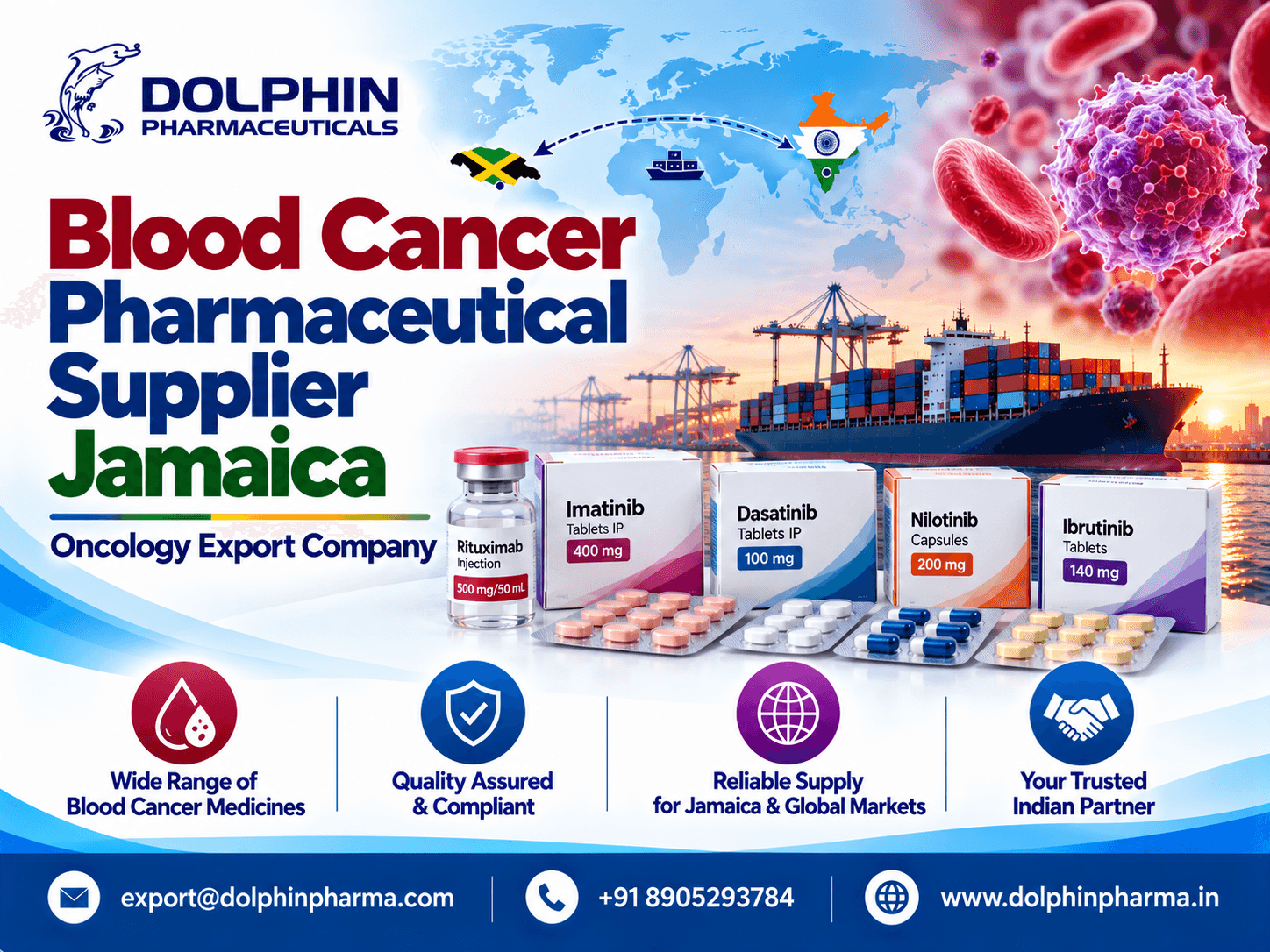
Dolphin Pharmaceuticals supports international pharmaceutical sourcing enquiries and works with buyers seeking information about pharmaceutical products and export supply arrangements. This guide explains the key considerations for Jamaican buyers evaluating a blood cancer medicine supplier or oncology pharmaceutical export company.
1. Understanding Blood Cancer Medicines
Blood cancer treatment varies according to the diagnosis, disease characteristics, patient needs, and recommendations of qualified healthcare professionals. Different conditions may require different medicine categories, and not every oncology product is suitable for every patient or healthcare facility.
The main blood cancer categories include:
- Leukemia: A group of cancers involving blood-forming tissues and blood cells.
- Lymphoma: Cancers that develop in the lymphatic system, including Hodgkin lymphoma and non-Hodgkin lymphoma.
- Multiple myeloma: A cancer involving plasma cells, which are part of the immune system.
Medicines used in oncology may include chemotherapy agents, targeted therapies, immunotherapies, and other specialist medicines. Their indications, formulations, strengths, handling requirements, and regulatory status can differ considerably.
For pharmaceutical buyers, the first step is to establish the exact product requirements. A supplier enquiry should identify the requested product name, active ingredient where applicable, strength, dosage form, pack size, manufacturer preference, estimated quantity, and destination market.
Product selection and treatment decisions must remain with appropriately qualified healthcare professionals. Pharmaceutical exporters should focus on supplying products that meet the buyer’s legitimate requirements and applicable regulatory conditions.
2. Why Jamaican Buyers Should Evaluate Oncology Export Companies Carefully
When sourcing blood cancer medicines, purchasing decisions should extend beyond the quoted price. Oncology products may require specialized documentation, controlled handling, and careful coordination between the exporter, importer, logistics provider, and receiving facility.
A reliable sourcing partner should help buyers clarify product specifications, identify available documentation, communicate relevant supply conditions, and coordinate export requirements.
Important evaluation criteria include:
Product identification: Confirm the exact medicine, strength, dosage form, pack configuration, and manufacturer.
Quality documentation: Ask which product-specific documents can be provided, such as a Certificate of Analysis, product specifications, and relevant manufacturing or quality certifications.
Regulatory suitability: Establish whether the product can legally be registered, imported, distributed, and sold in Jamaica.
Manufacturer transparency: Request the manufacturer’s details and verify the relevant manufacturing and distribution authorizations.
Supply planning: Discuss minimum order quantities, lead times, production or procurement schedules, and order confirmation procedures.
Communication: A suitable exporter should provide clear answers, realistic timelines, and transparent commercial terms.
These checks help Jamaican buyers reduce avoidable procurement risks and build more dependable pharmaceutical supply relationships.
3. Sourcing Blood Cancer Medicines from India for Jamaica
India offers a broad pharmaceutical manufacturing and export ecosystem. Depending on the product and applicable requirements, Jamaican importers may evaluate Indian suppliers for generic medicines and other pharmaceutical products.
However, the suitability of an Indian exporter depends on the particular medicine, its manufacturer, the available documentation, and the destination country’s regulatory requirements.
Before proceeding with an order, buyers should confirm the following:
- Whether the requested product is available through the proposed supply channel.
- Whether the manufacturer and product documentation can be verified.
- Whether the medicine meets the buyer’s specifications.
- Whether Jamaican registration, approval, and import permit requirements can be satisfied.
- Whether the proposed shipping and storage arrangements match the product’s requirements.
- Whether the exporter can provide a clear quotation and realistic supply schedule.
A pharmaceutical exporter should not be assumed to manufacture every medicine it supplies. Buyers should distinguish between a manufacturer, an authorized distributor, a sourcing partner, and an export company, then verify the role and credentials of the organization involved.
Dolphin Pharmaceuticals can be approached for pharmaceutical sourcing enquiries and discussions about export requirements. Product availability, manufacturer details, documentation, and Jamaica-specific eligibility should be confirmed for each individual enquiry.
4. Key Quality Checks Before Selecting a Supplier
Quality assurance is especially important when sourcing specialist medicines. Buyers should establish a documented review process before approving a supplier or placing an order.
Verify manufacturer credentials
Request the manufacturer’s legal name, manufacturing location, and relevant licences or certifications. Check that the documentation applies to the actual facility and product involved.
A certificate or licence should not be treated as proof of every product’s suitability for the Jamaican market. Its scope, validity, and relevance need to be reviewed.
Review product documentation
Depending on the product and transaction, relevant documents may include:
- Certificate of Analysis (CoA), where applicable.
- Product specification and approved product information.
- Manufacturing and quality-system documentation.
- Batch number and expiry-date information.
- Certificate of origin, when required.
- Safety data or handling information, where applicable.
- Shipping and temperature records for products requiring controlled conditions.
Not every document applies to every medicine or shipment. Buyers should establish the exact document set with their regulatory adviser and the relevant Jamaican authorities.
Confirm packaging and labelling
The packaging and labelling should correspond to the approved product presentation and applicable regulatory requirements. Buyers should review the product name, strength, dosage form, batch identification, expiry date, storage instructions, and other required information.
Any discrepancies should be resolved before the shipment is accepted.
Establish a traceability process
Buyers should understand how product batches are identified and traced through the supply chain. They should also confirm the procedures for reporting quality complaints, investigating discrepancies, handling product recalls, and communicating potential safety concerns.
These measures support accountability throughout the pharmaceutical supply process.
5. Understanding Jamaica’s Pharmaceutical Import Requirements
Regulatory compliance is a central consideration for any company exporting blood cancer medicines to Jamaica.
Jamaica’s Ministry of Health & Wellness, through its Standards and Regulation Division and Pharmaceutical and Regulatory Affairs functions, oversees pharmaceutical product registration and import permit processing. The Ministry states that most pharmaceutical products require registration before importation, distribution, and sale. Products intended for life-threatening illnesses, including cancer medicines, are among the categories assessed.
The applicable requirements depend on the specific product and circumstances. Jamaican importers should confirm the current requirements directly with the relevant authority before placing or shipping an order.
Key checks include:
- Product registration or approval: Confirm whether the specific medicine is registered or otherwise approved for the intended importation.
- Import permit: Determine which permit or authorization is required and who must apply.
- Importer authorization: Confirm that the Jamaican importing organization is appropriately authorized for the intended activity.
- Supporting documentation: Establish the required product information, application forms, and other supporting records.
- Customs clearance: Coordinate the commercial invoice, transport documents, permit information, and other required paperwork.
- Product-specific conditions: Confirm any special handling, labelling, or storage requirements.
A shipment should not proceed on the assumption that a medicine can be imported simply because it is available in India or another country. Product registration, import authorization, and importer eligibility should be confirmed before dispatch.
6. Supply Coordination for Kingston, Montego Bay, Portmore, and Saint Catherine
Pharmaceutical distributors and healthcare procurement teams across Jamaica may serve facilities in Kingston, Montego Bay, Portmore, Saint Catherine, and other locations. Their procurement needs can differ according to institutional requirements, storage capacity, ordering procedures, and distribution arrangements.
A well-planned supply process begins with a complete purchase enquiry. Buyers should provide the product specifications, requested quantity, destination, and expected delivery schedule. The exporter and importer can then review the product’s availability, documentation, commercial terms, and shipping options.
For multi-location distribution, buyers should also consider:
- Forecasting demand and planning replenishment.
- Coordinating delivery schedules with authorized receiving facilities.
- Maintaining appropriate stock rotation and expiry-date controls.
- Recording batch numbers and quantities received.
- Establishing procedures for handling damaged or temperature-exposed shipments.
- Maintaining traceability records for downstream distribution.
These practices help procurement teams manage stock responsibly and support continuity of supply. Actual delivery arrangements and lead times should always be confirmed for each order rather than assumed.
7. Storage and Transportation of Oncology Medicines
Some oncology medicines have specific storage, packaging, or transportation requirements. Certain products may require temperature-controlled distribution, protection from light, or other special handling conditions. Requirements vary by product and must be based on the manufacturer’s approved information.
Before shipment, the buyer and exporter should confirm:
- The product’s required storage temperature and permitted temperature range.
- Whether refrigerated or other temperature-controlled transport is necessary.
- Appropriate protective packaging and handling procedures.
- The availability of temperature-monitoring records, where required.
- The process for reporting shipping delays or temperature excursions.
- The receiving facility’s capacity to store the medicine correctly.
For products requiring a cold chain, the logistics plan should account for the entire journey, including transit, customs clearance, temporary storage, and final delivery. Any suspected temperature excursion should be assessed under the applicable quality procedure before the product is released for use.
Good logistics planning protects product integrity and helps avoid preventable losses.
8. Pricing and Commercial Considerations
Price is an important part of pharmaceutical procurement, but the lowest quotation does not necessarily provide the best overall value. Buyers should compare quotations using consistent product specifications and commercial terms.
A comprehensive quotation review may include:
- Product name, strength, dosage form, and pack size.
- Manufacturer and country of origin.
- Unit price and total order value.
- Minimum order quantity, if applicable.
- Product availability and estimated lead time.
- Packaging and shipping arrangements.
- Payment terms and quotation validity.
- Documentation included with the shipment.
- Responsibility for freight, insurance, duties, and other charges.
Buyers should also clarify how product substitutions, delays, short-dated stock, damaged shipments, and order changes are handled.
For oncology products, regulatory eligibility and quality documentation should be assessed alongside cost. A commercially attractive offer is not sufficient if the medicine does not meet the buyer’s specifications or applicable import requirements.
9. How Dolphin Pharmaceuticals Can Support International Buyers
Dolphin Pharmaceuticals focuses on pharmaceutical sourcing and export-related enquiries for international buyers. For Jamaican businesses evaluating blood cancer pharmaceutical supply options, a clear enquiry can help establish whether a suitable product and supply arrangement may be considered.
Buyers should provide the following information when making an enquiry:
- Requested medicine or active ingredient.
- Required strength and dosage form.
- Preferred manufacturer, if applicable.
- Quantity and pack-size requirements.
- Destination in Jamaica.
- Required product documentation.
- Expected purchasing timeline.
- Any known registration or import conditions.
With these details, the enquiry can be reviewed more efficiently. Product availability, sourcing arrangements, manufacturer information, documentation, pricing, and shipping feasibility must be confirmed individually.
Dolphin Pharmaceuticals should not be assumed to manufacture every requested medicine or to hold automatic approval for every product in Jamaica. Each supply proposal should be evaluated against the actual product, supply channel, and regulatory requirements.
10. Common Mistakes to Avoid When Choosing a Blood Cancer Medicine Supplier
Jamaican importers can improve procurement decisions by avoiding several common mistakes.
Choosing on price alone: A low quotation should never replace product verification, quality review, and regulatory checks.
Overlooking registration requirements: Confirm product eligibility and import authorization before ordering or dispatch.
Accepting incomplete documentation: Review the documents required for the product and transaction before approving the shipment.
Ignoring storage conditions: Confirm the correct storage and transportation requirements before arranging logistics.
Failing to verify the supplier’s role: Establish whether the company is the manufacturer, distributor, or export sourcing partner.
Not planning replenishment: Use demand forecasts and realistic lead times to support responsible stock planning.
Assuming every product is available: Confirm availability, manufacturer, pack size, and supply schedule for each enquiry.
A structured supplier assessment helps buyers make informed decisions and supports more reliable pharmaceutical procurement.
Frequently Asked Questions
1. How can I find a blood cancer pharmaceutical supplier for Jamaica?
Start by identifying the exact medicine and its specifications. Evaluate potential suppliers based on manufacturer credentials, product documentation, regulatory suitability, supply arrangements, and transparent commercial terms. Confirm Jamaican registration and import requirements before proceeding.
2. Can Jamaican buyers source oncology medicines from India?
Potentially, yes. The suitability of a product and exporter depends on the specific medicine, manufacturer, documentation, and applicable Jamaican requirements. Buyers should verify product eligibility and import authorization before placing or shipping an order.
3. What documents should I request from an oncology exporter?
Depending on the product, buyers may need a Certificate of Analysis, product specifications, manufacturing or quality documentation, batch and expiry information, certificate of origin, and relevant shipping records. The precise requirements should be confirmed for the individual product and transaction.
4. Are all blood cancer medicines approved for import into Jamaica?
No. Approval and import eligibility should be checked for each product. Availability in another country does not automatically authorize importation, distribution, or sale in Jamaica.
5. Does Dolphin Pharmaceuticals manufacture every oncology medicine it supplies?
Buyers should confirm the role of the company for each product enquiry. A pharmaceutical sourcing or export company may work with different manufacturers or supply channels. Manufacturer identity and product documentation should be verified individually.
6. What should I include in a pharmaceutical export enquiry?
Include the medicine name, strength, dosage form, quantity, preferred manufacturer if applicable, destination, required documentation, and purchasing timeline. These details help establish the relevant sourcing and export requirements.
Conclusion
Choosing a blood cancer pharmaceutical supplier in Jamaica requires careful consideration of product specifications, quality documentation, manufacturer credentials, regulatory requirements, storage conditions, and commercial transparency. For buyers evaluating an international oncology export company, the most useful approach is to verify each product and supply arrangement individually.
Indian pharmaceutical exporters may be worth evaluating when their products, documentation, and supply arrangements match the buyer’s requirements. However, all necessary Jamaican product approvals and import permissions must be confirmed before a shipment proceeds.
Dolphin Pharmaceuticals welcomes enquiries from pharmaceutical importers, distributors, and institutional procurement teams seeking information about pharmaceutical sourcing and export supply arrangements. Buyers can prepare a detailed product enquiry to discuss the requested medicine, documentation, quantity, and destination requirements.
The objective is to establish a transparent, compliant, and professionally managed supply process that supports responsible pharmaceutical procurement for Jamaica.
My Company Name - Dolphin Pharmaceuticals
My Website - https://www.dolphinpharma.in/