
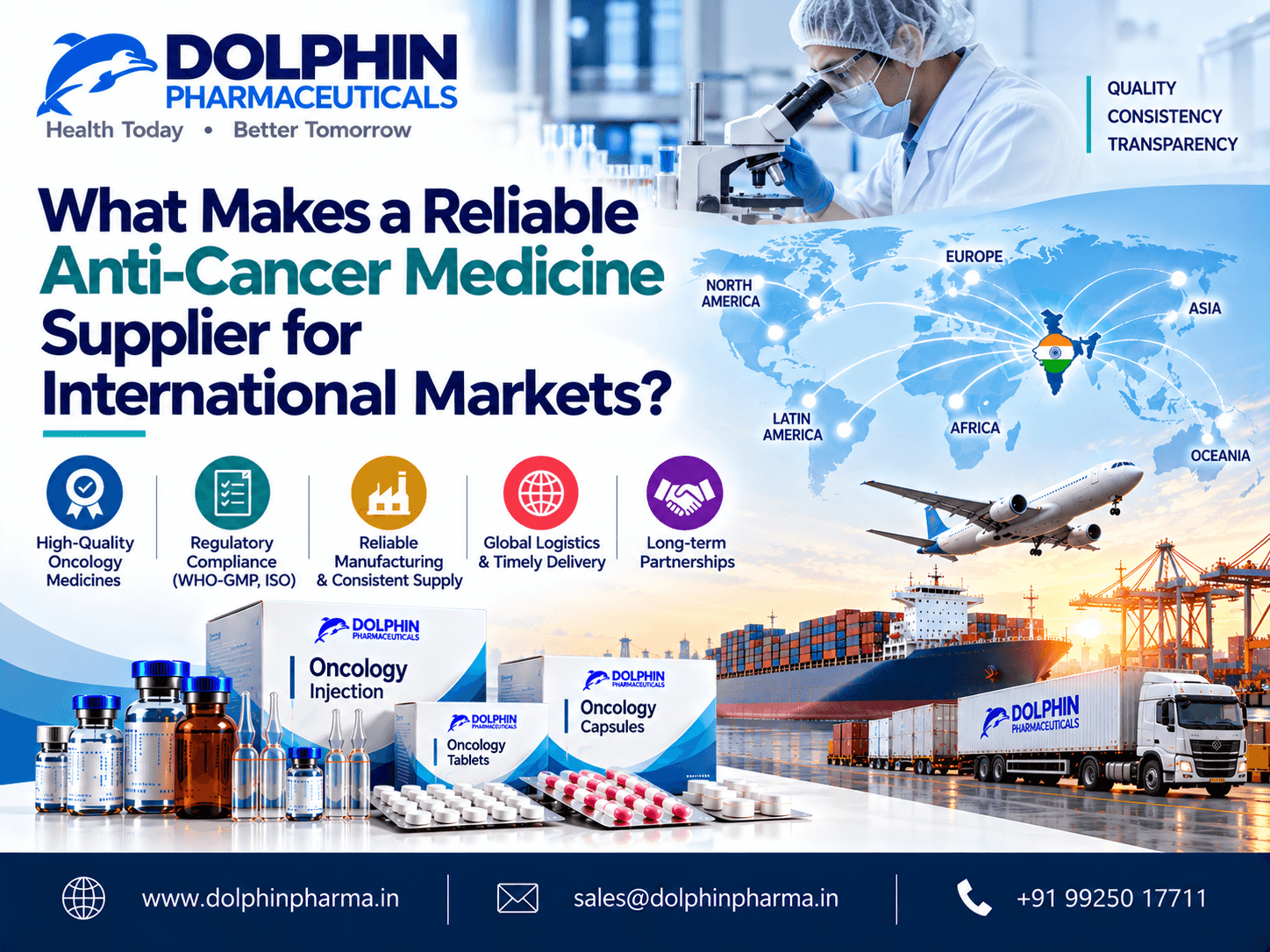
Introduction
Choosing a reliable anti-cancer medicine supplier is an important decision for pharmaceutical importers, licensed distributors, hospitals, and healthcare procurement teams. Unlike many general pharmaceutical products, oncology medicines require careful attention to product quality, regulatory compliance, documentation, storage conditions, and supply continuity.
For international buyers, selecting a supplier involves more than comparing quotations. Buyers need to understand where medicines are sourced, whether the relevant products meet destination-country requirements, which documents are available, and how the supplier manages orders and shipment coordination.
India is an important source of pharmaceutical products for international markets, including oncology medicines. However, buyers should assess every prospective supplier individually rather than assuming that all exporters offer the same standards, product range, or regulatory support.
A reliable anti-cancer medicine supplier should demonstrate transparent sourcing, appropriate quality documentation, regulatory awareness, dependable communication, and a clear process for handling international orders.
For global pharmaceutical buyers evaluating suppliers from India, this guide explains the key factors to consider before establishing a business relationship.
1. Verified Product Sourcing and Manufacturer Transparency
The first step in evaluating an anti-cancer medicine supplier is understanding where the products come from.
A supplier should be able to identify the relevant manufacturer or marketing authorization holder, as applicable, and provide accurate product information. This helps buyers evaluate the product's origin and determine whether it is suitable for their intended market.
Before placing an order, international buyers should check:
- The generic name and brand name, where applicable.
- The dosage strength and pharmaceutical dosage form.
- The manufacturer's name and relevant product details.
- The proposed pack size and packaging configuration.
- The country of origin and applicable product approvals.
- The availability of relevant product and batch documentation.
Manufacturer transparency is particularly important when a supplier offers medicines from several pharmaceutical companies. A trading or export company may source products from different manufacturers, so buyers should verify the source of each requested medicine rather than relying on the supplier's general company profile.
For example, Dolphin Pharma's online product catalogue lists selected oncology medicines with product names, strengths, packaging details, storage conditions, and manufacturer information. International buyers can use the catalogue as a starting point and confirm current availability and export eligibility directly with the company.
A transparent sourcing process helps buyers make informed procurement decisions and reduces uncertainty during supplier evaluation.
2. Quality Assurance and Product Documentation
Product quality should be one of the most important considerations when selecting an anti-cancer medicine supplier.
A supplier's claims alone are not enough. Buyers should request appropriate documents and assess whether they are authentic, current, relevant to the specific product, and acceptable to the destination country's regulatory authority.
Depending on the product, manufacturer, and importing market, relevant documents may include:
- Product specifications and approved product information.
- Certificate of Analysis (CoA), where applicable.
- Manufacturing or quality certifications relevant to the product.
- Manufacturing licence or other applicable authorization details.
- Batch number, manufacturing date, and expiry date information.
- Product registration or marketing authorization documentation, where required.
- Certificates of origin or other export documents, where applicable.
- Storage and transportation requirements.
Not every document applies to every medicine or shipment. Buyers should confirm the exact requirements with their regulatory team, importer, or competent authority.
A Certificate of Analysis, for instance, should relate to the relevant batch when a batch-specific certificate is required. Similarly, a general company certificate should not be treated as proof that every product supplied by that company has been approved in every destination country.
India's Central Drugs Standard Control Organisation (CDSCO) publishes regulatory guidance, including material concerning export permissions and good distribution practices for pharmaceutical products. Buyers and exporters should consult the applicable guidance for the product and transaction involved.
The key principle is simple: request product-specific evidence and verify it before confirming an order.
3. Regulatory Compliance in the Destination Country
A medicine that can be sourced in one country is not automatically permitted for import or sale in another.
International anti-cancer medicine suppliers must understand that pharmaceutical regulations vary across markets. Requirements may depend on the product, dosage form, manufacturer, intended use, import route, and local registration status.
Before placing an order, buyers should determine:
- Whether the product is authorized for import or supply in the destination market.
- Whether the importer holds the necessary licence or permit.
- Whether local product registration or a specific exemption is required.
- Whether the proposed manufacturer and product are acceptable to the relevant authority.
- Which labelling, language, packaging, and documentation rules apply.
- Whether any additional requirements apply to controlled, cold-chain, biological, or other specially regulated products.
The supplier should be willing to discuss these requirements and provide available supporting documentation. However, the importer should independently verify local legal requirements instead of assuming that the exporter can guarantee approval.
For buyers sourcing medicines from India, CDSCO's official guidance documents are a useful starting point for understanding relevant Indian regulatory procedures. Destination-country requirements must be checked separately with the appropriate local authority.
A supplier that communicates openly about compliance is generally easier to assess than one that makes broad promises without supporting documentation.
4. Product Range and Suitability for Procurement Needs
International buyers may need several oncology products across different therapeutic categories, strengths, and dosage forms. A supplier's catalogue can help determine whether it is worth initiating a procurement discussion.
Depending on the market and applicable approvals, oncology portfolios may include:
- Oral anti-cancer medicines, including selected tablets and capsules.
- Injectable oncology medicines.
- Targeted therapies.
- Hormonal therapies used in certain cancer treatments.
- Selected medicines used in supportive oncology care.
Not every supplier carries every category, and availability can change. Some products may require special handling, specific documentation, or additional regulatory checks.
When reviewing a supplier's portfolio, buyers should compare the exact product rather than just the therapeutic category. Confirm the generic name, strength, dosage form, pack size, manufacturer, storage requirements, and proposed shelf life.
For example, two products containing the same active ingredient may differ in manufacturer, presentation, packaging, registration status, or availability in the intended market. These differences may affect procurement suitability.
A supplier with a clearly presented catalogue and a process for confirming product-specific details can make sourcing more efficient.
5. Reliable Storage, Handling, and Transportation
Oncology medicines may have specific storage and handling requirements. Some products can be stored under controlled room-temperature conditions, while others require refrigeration or additional precautions.
A reliable supplier should communicate the storage requirements for the exact product being quoted and explain how the shipment will be managed.
Buyers should verify:
- The storage conditions stated in the product information.
- Any temperature limits or special handling instructions.
- The proposed packaging and protection during transportation.
- Whether temperature monitoring is necessary for the product.
- The planned shipping route and expected transit time.
- Procedures for handling delays or temperature excursions, where relevant.
- The remaining shelf life expected at delivery.
Cold-chain products require particular attention. A supplier should not describe a shipment as temperature-controlled unless the arrangements support that claim and are appropriate for the product.
Buyers should also establish who is responsible for freight, insurance, customs clearance, and any special handling arrangements. Responsibilities should be documented before dispatch.
Good distribution practices are important because product quality must be maintained throughout the supply chain, not merely at the point of manufacture. CDSCO publishes guidance on good distribution practices for pharmaceutical products that can help businesses understand relevant considerations.
Clear storage and shipping procedures reduce avoidable confusion and support more effective procurement planning.
6. Consistent Communication and Order Management
A supplier's communication practices can provide useful insight into how it manages international business.
During the enquiry stage, buyers should observe whether the supplier responds clearly to product questions, provides complete quotations, and explains which details still need confirmation.
A professional supplier should be able to discuss:
- Product availability and sourcing status.
- Minimum order quantities, where applicable.
- Quotation validity and currency.
- Lead times and estimated dispatch arrangements.
- Payment terms and commercial conditions.
- Required buyer documents.
- Export documentation and shipping responsibilities.
- Procedures for reporting discrepancies or damaged shipments.
The supplier should distinguish between confirmed information and estimates. For example, an estimated dispatch date should not be presented as a guaranteed delivery date when approvals, stock, customs, or transportation may affect the timeline.
Written communication is especially useful when several stakeholders are involved, such as a purchasing manager, regulatory team, customs agent, and receiving warehouse.
Before confirming an order, buyers should ensure that the quotation, product details, quantity, pricing, delivery responsibilities, and agreed documentation are recorded clearly.
7. Transparent Pricing and Commercial Terms
Price is an important factor in pharmaceutical procurement, but the lowest quotation is not always the most suitable option.
A meaningful comparison should consider the complete commercial offer. One supplier's quotation may exclude freight or special packaging, while another may include different delivery terms or offer a different product presentation.
Before comparing quotations, confirm:
- The exact medicine, strength, dosage form, and manufacturer.
- The quantity and pack configuration.
- The quoted price and currency.
- The quotation's validity period.
- Shipping, insurance, and other applicable charges.
- Payment terms and any advance-payment conditions.
- Delivery responsibilities under the agreed trade terms.
- Any applicable import duties, taxes, or local charges.
Buyers should also clarify the process for handling shortages, damaged packaging, incorrect products, or discrepancies in supplied documentation.
A written agreement can establish how both parties will handle these situations and reduce the risk of misunderstandings.
The objective should be to identify a commercially competitive supplier whose offer is transparent, verifiable, and suitable for the buyer's regulatory and operational requirements.
8. Supply Continuity and Inventory Planning
International pharmaceutical buyers often need to plan procurement around demand forecasts, regulatory timelines, stock levels, and shipping lead times.
For oncology medicines, supply interruptions can create significant operational challenges for hospitals, distributors, and pharmacy procurement teams. This makes realistic supply planning an important part of supplier evaluation.
Buyers should ask prospective suppliers about their process for confirming stock, sourcing products, estimating lead times, and communicating delays.
Useful questions include:
- Is the requested product currently available, or will it need to be sourced?
- What is the estimated lead time before dispatch?
- Can the supplier provide an update if availability changes?
- What remaining shelf life can be expected at delivery?
- Are alternative presentations legally and commercially acceptable, if needed?
- How are urgent enquiries and order changes handled?
A supplier should not promise uninterrupted availability unless it can substantiate that commitment. Instead, it should provide realistic information and communicate changes promptly.
Buyers can support continuity by sharing forecasts where appropriate, placing orders with sufficient lead time, and maintaining suitable procurement contingency plans.
Long-term supply arrangements should be based on documented performance rather than verbal assurances alone.
9. Traceability, Complaints, and Product Recalls
Traceability is another essential consideration when selecting an anti-cancer medicine supplier.
Buyers should understand how the supplier records product and batch information and how it responds if a quality concern, complaint, or recall arises.
Before entering a supply agreement, consider whether the supplier can explain:
- How batch and expiry details are documented.
- Which documents accompany the supplied product.
- How product complaints are received and escalated.
- How suspected quality issues are communicated.
- How relevant recall or safety information is handled.
- Who should be contacted if a shipment discrepancy is identified.
The specific responsibilities of the supplier, manufacturer, marketing authorization holder, and importer depend on the product and applicable regulations. These roles should be clarified rather than assumed.
Buyers should also establish a process for checking products upon receipt and maintaining appropriate records. If a potential quality issue is identified, the affected product should be handled according to applicable procedures and the advice of qualified personnel and relevant authorities.
A supplier's willingness to explain its complaint and traceability processes is a valuable part of due diligence.
10. Reputation, Experience, and Long-Term Business Relationships
A company's website and marketing materials are useful starting points, but they should not be the only basis for choosing a supplier.
International buyers should conduct reasonable due diligence before committing to a new business relationship. This may include verifying company registration details, reviewing relevant licences and certificates, confirming contact information, checking trade references where available, and examining the supplier's responsiveness during the quotation process.
Buyers should be cautious about unsupported claims such as guaranteed regulatory approval in every country, unlimited stock availability, or assured delivery regardless of circumstances.
A dependable business relationship develops through consistent performance, clear communication, accurate documents, fair commercial practices, and appropriate handling of problems.
For repeat orders, buyers can evaluate supplier performance using practical measures such as:
- Accuracy of supplied product and order documentation.
- Adherence to agreed dispatch timelines.
- Responsiveness to enquiries and changes.
- Accuracy of quantities and product presentations.
- Handling of complaints and discrepancies.
- Consistency of agreed commercial terms.
Reviewing these factors periodically can help procurement teams identify areas for improvement and make better-informed sourcing decisions.
11. How International Buyers Can Evaluate Dolphin Pharmaceuticals
Dolphin Pharmaceuticals can be considered as one potential contact for international buyers exploring pharmaceutical sourcing from India. Its online catalogue provides a starting point for reviewing selected products and identifying items for further enquiry.
Buyers can visit the Dolphin Pharma product catalogue to review listed medicines and product information. The catalogue includes selected oncology products, with details such as generic names, strengths, packaging, storage conditions, and manufacturer information.
Before placing an order, buyers should contact the company to confirm:
- Whether the requested product is currently available for sourcing.
- The exact manufacturer, brand, strength, and pack size.
- Which quality and regulatory documents can be supplied.
- Whether the product can legally be exported to the destination market.
- The proposed price, lead time, shelf life, and shipping terms.
- Any additional documentation required from the importing company.
Product listings should be treated as an initial reference, not as a guarantee of stock, destination-country registration, or export eligibility.
International buyers should verify the details relevant to their own market and procurement requirements before proceeding.
12. Practical Checklist Before Choosing a Supplier
Use the following checklist when assessing a potential anti-cancer medicine supplier.
- Manufacturer and product sourcing details are clear.
- Product name, strength, dosage form, and packaging are confirmed.
- Relevant quality documents are available and can be verified.
- Destination-country import and registration requirements have been checked.
- Storage and transportation conditions are appropriate for the product.
- Price, payment, freight, and delivery terms are documented.
- Product availability and estimated lead times are confirmed.
- Batch traceability and complaint-handling processes are understood.
- Company credentials and contact details have been checked.
- Both parties understand their responsibilities before shipment.
Completing these checks will not eliminate every risk, but it provides a more structured foundation for evaluating suppliers and making procurement decisions.
Frequently Asked Questions (FAQs)
1. What makes a reliable anti-cancer medicine supplier?
A reliable supplier demonstrates transparent product sourcing, provides appropriate and verifiable documentation, understands export and import requirements, communicates clearly, and explains its storage, shipping, traceability, and complaint-handling procedures.
2. Why is manufacturer verification important when importing oncology medicines?
Manufacturer verification helps buyers establish product origin and assess whether the product meets their procurement and regulatory requirements. It also helps distinguish between suppliers that manufacture products and those that source products from other manufacturers.
3. Which documents should international buyers request?
Depending on the product and destination market, buyers may need product specifications, batch-specific quality documents, relevant manufacturing or quality certifications, product authorizations, and export or origin documents. The precise list should be confirmed with the destination-country authority or qualified regulatory adviser.
4. Can an Indian anti-cancer medicine supplier export every oncology product to every country?
No. Export eligibility and import permission depend on the product, applicable Indian requirements, and the destination country's laws. Buyers should verify the requirements for each medicine and proposed transaction before ordering.
5. Should buyers select an oncology medicine supplier based only on price?
No. Price should be considered alongside product suitability, documentation, regulatory compliance, storage arrangements, shelf life, shipping terms, and supplier performance. A low quotation is not sufficient evidence of a suitable or reliable supply arrangement.
6. How can buyers begin an enquiry with Dolphin Pharmaceuticals?
Buyers can review the online product catalogue, identify the required medicine and specifications, and contact the company to discuss availability, documentation, export eligibility, pricing, and shipping arrangements. All details should be confirmed before placing an order.
Conclusion
Choosing a reliable anti-cancer medicine supplier for international markets requires careful evaluation of sourcing transparency, quality documentation, regulatory compliance, logistics, commercial terms, and supply management.
International buyers should look beyond catalogue size and attractive prices. They should ask specific questions, verify documents, assess the requirements of their destination market, and establish clear written terms before confirming an order.
A supplier that communicates honestly, supports appropriate due diligence, and provides clear product and shipment information can help buyers build a more dependable procurement relationship.
Looking for oncology medicine sourcing options from India? Explore the Dolphin Pharma product catalogue and contact the team to discuss your product requirements, documentation needs, destination market, and proposed order. Confirm current availability and export eligibility before proceeding with procurement.
My Company Name - Dolphin Pharmaceuticals
My Website - https://www.dolphinpharma.in/