
Introduction
International pharmaceutical trade requires careful preparation, especially when suppliers handle oncology medicines. Pharmaceutical importers, distributors, hospital procurement teams, and healthcare organizations need more than a product quotation before proceeding with an international order. They must establish whether the requested medicine can be supplied legally, whether the necessary documentation is available, and whether the product can be stored and transported under appropriate conditions.
For suppliers in India, export readiness involves several interconnected responsibilities. These may include verifying product sourcing, checking applicable export requirements, preparing accurate documentation, coordinating with manufacturers, confirming destination-country regulations, and planning international transportation.
Oncology medicines may include tablets, capsules, injections, targeted therapies, and biological products. Each product can have different regulatory, quality, packaging, and storage requirements. A process suitable for one medicine may not be suitable for another.
Pharmaceutical export readiness means ensuring that the product, documentation, regulatory requirements, commercial arrangements, and shipment process are appropriately prepared before an order proceeds.
For oncology medicine suppliers, this preparation helps identify potential issues early and supports more transparent communication with international buyers.
This guide explains the essential export-readiness checks that pharmaceutical suppliers should consider and the questions buyers can ask when evaluating an Indian oncology medicine export partner.
1. Verify the Product and Manufacturer Before Accepting an Order
The first step in export readiness is to establish exactly which product the buyer requires and where it will be sourced.
An exporter may manufacture medicines directly, distribute products from another manufacturer, or coordinate sourcing through third-party pharmaceutical companies. The supplier should clearly identify its role rather than implying that it manufactures every product in its catalogue.
Before confirming an order, verify:
- Generic name and brand name, where applicable.
- Strength and dosage form.
- Pack size and packaging configuration.
- Manufacturer's legal name and product origin.
- Storage conditions stated for the product.
- Current sourcing or availability status.
- Product registration or authorization requirements in the destination market.
- Any special handling or documentation requirements.
These details should be consistent across the quotation, purchase order, product documents, and shipping records.
For example, a buyer requesting a particular strength of an oral oncology medicine should not receive a quotation that simply identifies the active ingredient. The exact strength, dosage form, manufacturer, and packaging should be clarified.
If the supplier sources the product from another company, it should identify the manufacturer and explain which product-specific documents can be provided.
This initial verification reduces the risk of confusion during documentation, regulatory checks, and shipment preparation.
2. Confirm Export Eligibility and Destination-Country Requirements
A medicine's availability in India does not automatically mean it can be exported to every country or imported into every market.
Export eligibility depends on the product, applicable Indian requirements, the proposed transaction, and the destination country's regulatory framework. Certain products may require specific permissions or additional documentation.
Before confirming a shipment, the supplier and buyer should establish:
- Whether the product can legally be exported under the applicable Indian requirements.
- Whether any product-specific export permission or authorization is necessary.
- Whether the product is registered or otherwise permitted for import in the destination market.
- Whether the importing company holds the necessary licence or permit.
- Whether the manufacturer and product are acceptable to the destination regulator.
- Whether local packaging, labelling, or language requirements apply.
- Which documents must accompany the shipment.
India's Central Drugs Standard Control Organisation (CDSCO) publishes guidance documents that include export-related procedures for certain categories of drugs. Suppliers should review the guidance relevant to their specific products rather than assuming that the same process applies to every medicine.
International buyers should also confirm requirements with the competent authority in their destination country or a qualified regulatory professional.
For example, a shipment intended for Jamaica may be subject to requirements that differ from those for another Caribbean country, an African market, or a Southeast Asian market. The same product may therefore require different regulatory checks depending on the destination.
Export readiness begins with verifying eligibility, not merely preparing a commercial invoice.
3. Prepare a Product-Specific Documentation Checklist
Documentation is a central part of pharmaceutical export readiness. Missing, inconsistent, outdated, or unsuitable documents can create delays during regulatory review, customs clearance, or receipt of the goods.
The supplier should establish which documents are required for the particular medicine, manufacturer, destination, and transaction.
Depending on applicable requirements, the documentation checklist may include:
- Commercial quotation and purchase order.
- Product specifications.
- Relevant manufacturing or quality certifications.
- Certificate of Analysis (CoA), where applicable.
- Product registration or authorization documents, where required.
- Manufacturing licence or other applicable authorization information.
- Batch number, manufacturing date, and expiry date information.
- Certificate of origin, where applicable.
- Commercial invoice and packing list.
- Applicable export permits or other regulatory documents.
- Shipping and transport documents.
- Product-specific storage and handling instructions.
Not every document applies to every product or shipment. The precise list should be confirmed with the relevant authorities and parties involved.
The supplier should also distinguish between documents it can issue directly and documents that must be obtained from the manufacturer, a government authority, a chamber of commerce, or another authorized organization.
Check documents for consistency
Before dispatch, review key information across the relevant records.
The product name, strength, dosage form, manufacturer, quantities, and packaging details should match the agreed order. Batch and expiry details should be checked where they are required and available at that stage.
Documents should be current, legible, authentic, and appropriate for their intended use. Where necessary, verify certificates with the issuing organization.
A general company certificate should not be treated as proof that every product is authorized in every destination country.
Establishing a document checklist early helps the supplier identify missing items before the shipment reaches a critical stage.
4. Verify Quality Assurance and Good Distribution Practices
Export readiness is not just about legal paperwork. Suppliers should also consider how the product's quality is protected throughout the supply chain.
Quality requirements vary by product and by the roles of the manufacturer, exporter, distributor, and importer. Suppliers should understand their responsibilities and obtain the appropriate evidence from the parties involved.
Relevant checks may include:
- Confirming the manufacturer's identity and applicable credentials.
- Reviewing relevant product and batch documentation.
- Checking the product's storage and handling requirements.
- Confirming that packaging is suitable for transportation.
- Maintaining appropriate distribution and shipment records.
- Establishing procedures for handling complaints and discrepancies.
- Understanding the process for communicating relevant recall information.
CDSCO publishes guidance on good distribution practices for pharmaceutical products. Such guidance is relevant when considering how products should be handled and distributed through the supply chain.
Exporters should review applicable requirements and establish suitable processes for the products they handle.
Suppliers should avoid unsupported statements such as claiming that every product is approved worldwide or that a single company-level certificate proves the quality status of an entire product portfolio.
Instead, they should provide accurate product-specific information and make relevant supporting documents available for verification.
5. Confirm Storage, Packaging, and Temperature Requirements
Oncology medicines do not all have the same storage needs. Some products may require storage below a specified temperature, while others may require refrigeration or additional precautions.
Suppliers should identify the manufacturer's storage instructions for each product before arranging transportation.
Important checks include:
- The required storage temperature and permitted conditions.
- Whether refrigeration or a cold chain is necessary.
- Protection from light, moisture, or other specified conditions.
- Packaging requirements for the particular dosage form.
- Temperature monitoring requirements, where applicable.
- Expected transit time and proposed shipping route.
- Procedures for managing delays or temperature excursions.
- Remaining shelf life expected at delivery.
For a product requiring refrigeration, the supplier should confirm how the appropriate temperature will be maintained and documented during transportation. Ordinary shipping arrangements should not be assumed to be suitable for every product.
The exporter and importer should also clarify who is responsible for freight, insurance, customs clearance, special packaging, and any temperature-controlled transport.
These responsibilities should be documented before dispatch.
Product-specific handling is especially important when suppliers source both room-temperature products and medicines that require more specialized logistics. A single general shipping procedure may not adequately address every product.
6. Check Labelling and Packaging Requirements
Labelling and packaging requirements can differ across countries and product categories. Exporters should verify the requirements that apply to the specific product and destination before preparing a shipment.
Relevant considerations may include:
- Product name and strength.
- Dosage form and pack configuration.
- Manufacturer identification.
- Batch and expiry information.
- Required storage instructions.
- Required language and labelling format.
- Product registration or authorization details, where applicable.
- Tamper-evident or other packaging requirements, where applicable.
Suppliers should not alter product labelling or packaging without confirming that the proposed arrangement is permitted.
For some products and destinations, additional requirements may apply to package inserts, language, serialization, or other product-identification information. These should be confirmed with the relevant authority or qualified regulatory adviser.
Before dispatch, compare the approved or accepted product presentation with the documentation and shipment details.
Clear packaging and labelling checks help prevent avoidable issues during import review and receiving inspection.
7. Establish a Reliable Export Documentation Workflow
Pharmaceutical export readiness improves when each stage has a clear owner and a defined completion check.
A supplier can establish a practical workflow that connects the buyer's enquiry with product verification, regulatory review, order confirmation, documentation, and shipment coordination.
Step 1: Record the buyer's requirements
Capture the requested product, strength, dosage form, quantity, destination country, preferred manufacturer where applicable, and required delivery timeline.
Step 2: Verify product sourcing
Confirm the manufacturer, current sourcing status, product presentation, and availability of the requested medicine.
Step 3: Review regulatory requirements
Identify applicable Indian export requirements and the destination country's import, registration, and documentation conditions.
Step 4: Prepare a product-specific document list
Determine which documents are available, which must be requested from the manufacturer, and which must be issued by the appropriate authority.
Step 5: Confirm commercial terms
Agree on the product, quantity, price, currency, payment conditions, delivery responsibilities, and other relevant terms in writing.
Step 6: Complete pre-dispatch checks
Verify product details, documents, packaging, storage arrangements, and shipment instructions before dispatch.
Step 7: Coordinate shipment and retain records
Prepare the applicable shipping documents, coordinate transportation, communicate shipment details, and retain appropriate records.
This workflow should be adapted to the product, transaction, and applicable requirements. It is a practical planning structure, not a substitute for legal or regulatory advice.
8. Evaluate Shelf Life and Inventory Planning
Shelf life is an important consideration when preparing an international pharmaceutical shipment.
Buyers may have specific requirements for the minimum remaining shelf life at delivery. These requirements can depend on local regulations, procurement contracts, distribution arrangements, and expected inventory turnover.
Before confirming an order, the supplier and buyer should agree on:
- The required quantity and pack size.
- Any minimum remaining shelf-life requirement.
- The expected dispatch timeline.
- The estimated transit period.
- The inventory and receiving arrangements.
- The process for communicating changes in availability.
The expected shelf life should be confirmed against the actual product being supplied, not assumed from an earlier quotation or catalogue entry.
Buyers should also plan orders with sufficient time for regulatory checks, documentation, shipment, and receiving procedures.
Suppliers should communicate whether a product is currently available or needs to be sourced. Estimated dispatch dates should be clearly distinguished from confirmed dates, particularly when product sourcing or regulatory steps remain outstanding.
Realistic inventory planning helps both parties coordinate orders without making unsupported promises about continuous availability.
9. Clarify Commercial Terms and Shipment Responsibilities
An export-ready order requires clear commercial arrangements as well as compliant product documentation.
Before accepting the order, the supplier and buyer should agree on the complete commercial offer.
The quotation should clarify:
- Product name, strength, manufacturer, and pack size.
- Quantity and unit price.
- Currency and quotation validity.
- Payment terms.
- Applicable freight and insurance charges.
- Delivery terms and responsibilities.
- Estimated preparation and dispatch timeline.
- Required documentation and any additional charges.
- Procedures for managing shortages, discrepancies, or damaged shipments.
Where relevant, the parties should specify their responsibilities for customs clearance and import duties or taxes.
Buyers should compare equivalent products and commercial terms when assessing quotations from different suppliers. A lower price may reflect differences in manufacturer, packaging, freight, or other conditions.
Suppliers should avoid confirming a delivery commitment before the necessary product, documentation, and logistics checks have been completed.
Written commercial terms help both parties understand their obligations and provide a useful reference if questions arise during fulfilment.
10. Prepare for Complaints, Recalls, and Traceability
A complete export-readiness process should include procedures for handling issues that arise after dispatch.
The supplier should understand how product information is recorded and how relevant concerns are communicated to the manufacturer, importer, or other responsible parties.
Before beginning a supply relationship, clarify the procedures for:
- Recording product and batch information.
- Reporting damaged or incorrect shipments.
- Communicating documentation discrepancies.
- Escalating suspected quality issues.
- Handling relevant product recall communications.
- Maintaining shipment and distribution records.
- Identifying the responsible contact for each issue.
The specific responsibilities of manufacturers, exporters, distributors, and importers depend on the product and applicable regulations. They should be clearly understood rather than assumed.
If a potential quality issue arises, the affected product should be managed in accordance with applicable procedures and the advice of qualified personnel and relevant authorities.
Clear complaint-handling and traceability arrangements help the parties respond more systematically when a problem needs investigation.
11. Common Export-Readiness Mistakes to Avoid
Even an experienced supplier can encounter problems if essential checks are left until the final stage.
Common mistakes include:
Assuming a catalogue listing confirms availability. A product page is an initial reference. Current sourcing status, product details, and export eligibility should be confirmed separately.
Using the same document checklist for every country. Requirements can differ by destination, product, and transaction. Use a country- and product-specific checklist.
Confusing manufacturer credentials with product approval. A company's general credentials do not automatically establish that every medicine it offers is authorized in a particular market.
Overlooking storage requirements. Transportation arrangements must match the manufacturer's instructions for the specific product.
Leaving documentation until dispatch. Missing or inconsistent documents can delay a shipment. Identify required documents early.
Making unsupported delivery promises. Availability, approvals, customs procedures, and transportation can affect timelines. Communicate estimates accurately.
Failing to document responsibilities. Written agreements help clarify who is responsible for freight, insurance, import clearance, and other arrangements.
Avoiding these mistakes can make export preparation more structured and reduce preventable delays.
12. How International Buyers Can Assess an Export-Ready Oncology Supplier
International buyers can use the following checklist when evaluating an oncology medicine supplier.
- The supplier's role and the actual manufacturer are clear.
- The exact product, strength, dosage form, and pack size are confirmed.
- Applicable export requirements have been checked.
- Destination-country import and registration requirements have been verified.
- Relevant quality and product documents are available.
- Packaging and labelling requirements are understood.
- Storage and transportation arrangements match product requirements.
- Remaining shelf life and estimated transit time are agreed.
- Pricing, payment, freight, and delivery responsibilities are documented.
- Complaint-handling and traceability processes are understood.
- Current availability and export eligibility have been confirmed before dispatch.
This checklist is a starting point for due diligence. The final requirements should be adapted to the specific medicine, destination market, and transaction.
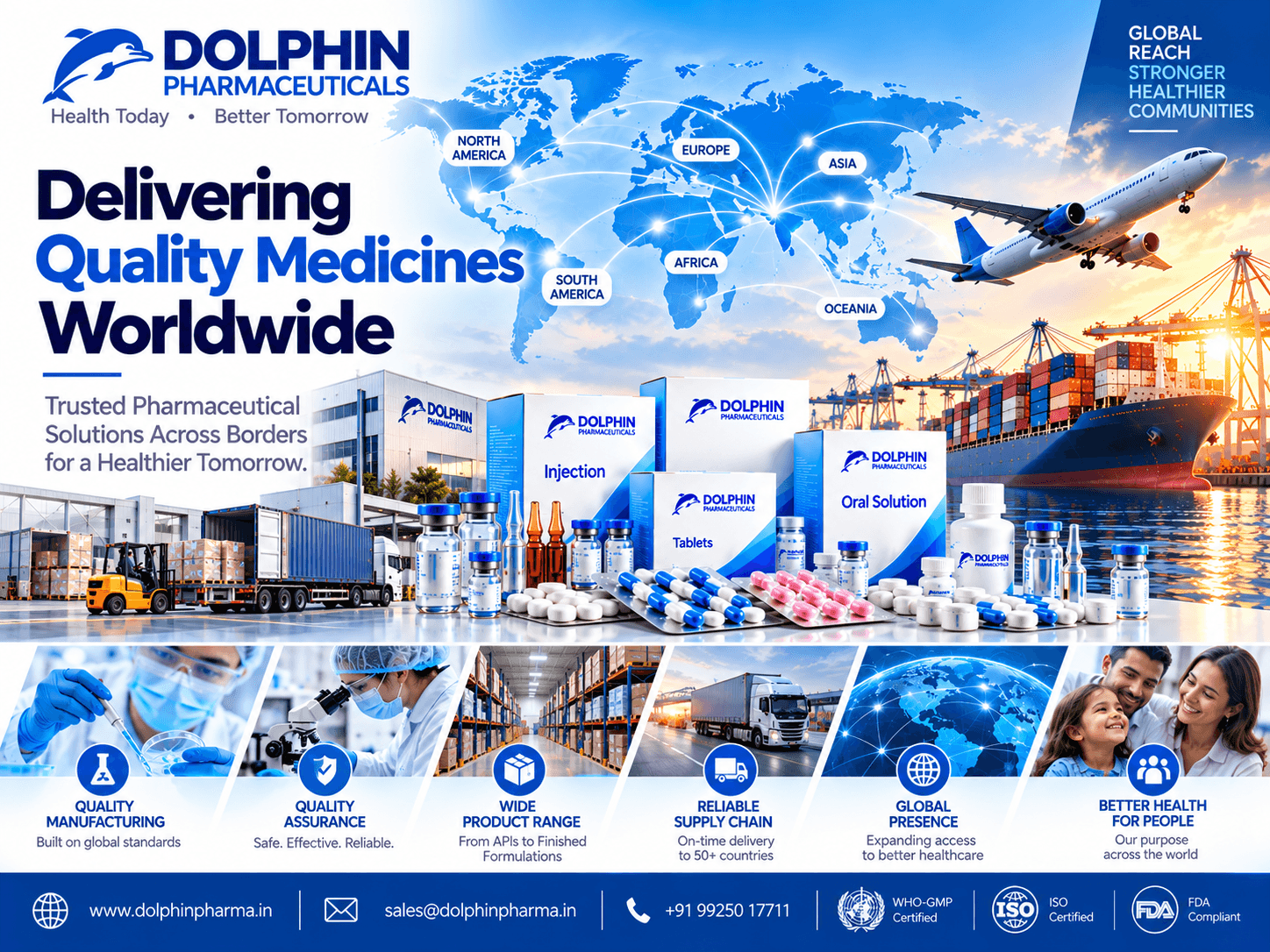
13. Exploring Oncology Medicine Sourcing Through Dolphin Pharmaceuticals
Dolphin Pharmaceuticals can be considered as one potential contact for international buyers exploring pharmaceutical sourcing options from India.
The Dolphin Pharma website provides a product catalogue that includes selected oncology medicines, along with product information such as generic names, strengths, packaging, storage conditions, and manufacturer details for listed products.
International buyers can review the Dolphin Pharma product catalogue to identify medicines for further discussion.
For a more efficient enquiry, buyers should provide:
- The requested generic name or brand.
- Strength and dosage form.
- Preferred manufacturer, if applicable.
- Quantity and packaging requirements.
- Destination country.
- Applicable registration or documentation requirements.
- Preferred delivery timeline.
Before placing an order, buyers should confirm current availability, actual manufacturer, relevant documents, commercial terms, shipping arrangements, and eligibility for export to the intended market.
Product listings are an initial reference, not a guarantee of current stock, regulatory approval in every country, or export eligibility for every transaction.
Dolphin Pharmaceuticals should be assessed against the same product-specific, regulatory, quality, and logistics criteria that buyers apply to any prospective supplier.
Frequently Asked Questions
1. What does pharmaceutical export readiness mean?
Pharmaceutical export readiness means checking that a product, its documentation, applicable export and import requirements, commercial arrangements, and shipping plans are appropriately prepared before an international order proceeds.
2. Which documents are needed to export oncology medicines from India?
Requirements depend on the product, transaction, and destination country. Documents may include product specifications, relevant quality documents, manufacturing or product authorization information, batch details, commercial invoices, packing lists, and applicable export or shipping documents. The exact list should be verified with the relevant authorities and parties.
3. Can all oncology medicines be exported from India?
No. The ability to export a medicine depends on applicable Indian requirements and the product's eligibility for the proposed transaction. The destination country may also require registration, import authorization, or other documentation.
4. Why are storage and transportation checks important?
Different medicines have different storage requirements. Some products require refrigeration or other specific handling conditions. Exporters should confirm the manufacturer's instructions and arrange suitable transportation for each product.
5. When should export documentation be checked?
Documentation requirements should be identified early in the enquiry and order process. Product-specific documents should be reviewed before shipment, with enough time to resolve missing or inconsistent information.
6. How can an international buyer assess whether a supplier is export-ready?
Buyers can check manufacturer transparency, product eligibility, relevant documentation, packaging, storage, shipment planning, commercial terms, and complaint-handling procedures. Requirements should be verified for the actual product and destination market.
7. How can buyers enquire about oncology medicines from Dolphin Pharmaceuticals?
Buyers can review the online product catalogue and submit an enquiry specifying the requested medicine, strength, quantity, destination country, and documentation needs. Availability, pricing, product origin, and export eligibility should be confirmed before an order is placed.
Conclusion
Pharmaceutical export readiness is an essential part of responsible international oncology medicine sourcing. Suppliers need to consider product eligibility, manufacturer information, documentation, quality assurance, packaging, storage, commercial terms, and shipment planning before an order is dispatched.
For international buyers, the process begins with a clearly defined product requirement and continues through regulatory verification, document review, and confirmation of the final shipping arrangements.
A structured export-readiness process helps identify potential problems earlier, clarifies the responsibilities of each party, and supports more transparent business relationships.
Looking for oncology medicine sourcing options from India? Explore the Dolphin Pharma product catalogue and contact the team with your product specifications and destination-market requirements. Confirm current availability, documentation, and export eligibility before proceeding with procurement.
My Company Name - Dolphin Pharmaceuticals
My Website - https://www.dolphinpharma.in/