
Introduction
Consistent medicine supply is essential for pharmaceutical importers, wholesalers, distributors, hospitals, and healthcare procurement organisations. When medicines are sourced internationally, maintaining a dependable supply requires more than finding a supplier with competitive prices. Buyers must evaluate product quality, manufacturer credentials, documentation, inventory availability, shipping arrangements, and the supplier's ability to communicate clearly throughout the procurement process.
A supply interruption can create operational challenges for distributors and healthcare organisations. Delayed shipments, incomplete documents, unexpected product substitutions, or insufficient remaining shelf life can affect purchasing plans and downstream distribution.
Choosing the right pharmaceutical export partner is therefore a strategic business decision. Importers should look for a supplier that understands their requirements, provides transparent product information, supports the necessary documentation process, and works towards consistent performance across repeat orders.
India is an important source of pharmaceutical products for international markets. However, buyers should evaluate each exporter and product individually, confirming the actual manufacturer, product availability, quality documentation, and eligibility for the destination market.
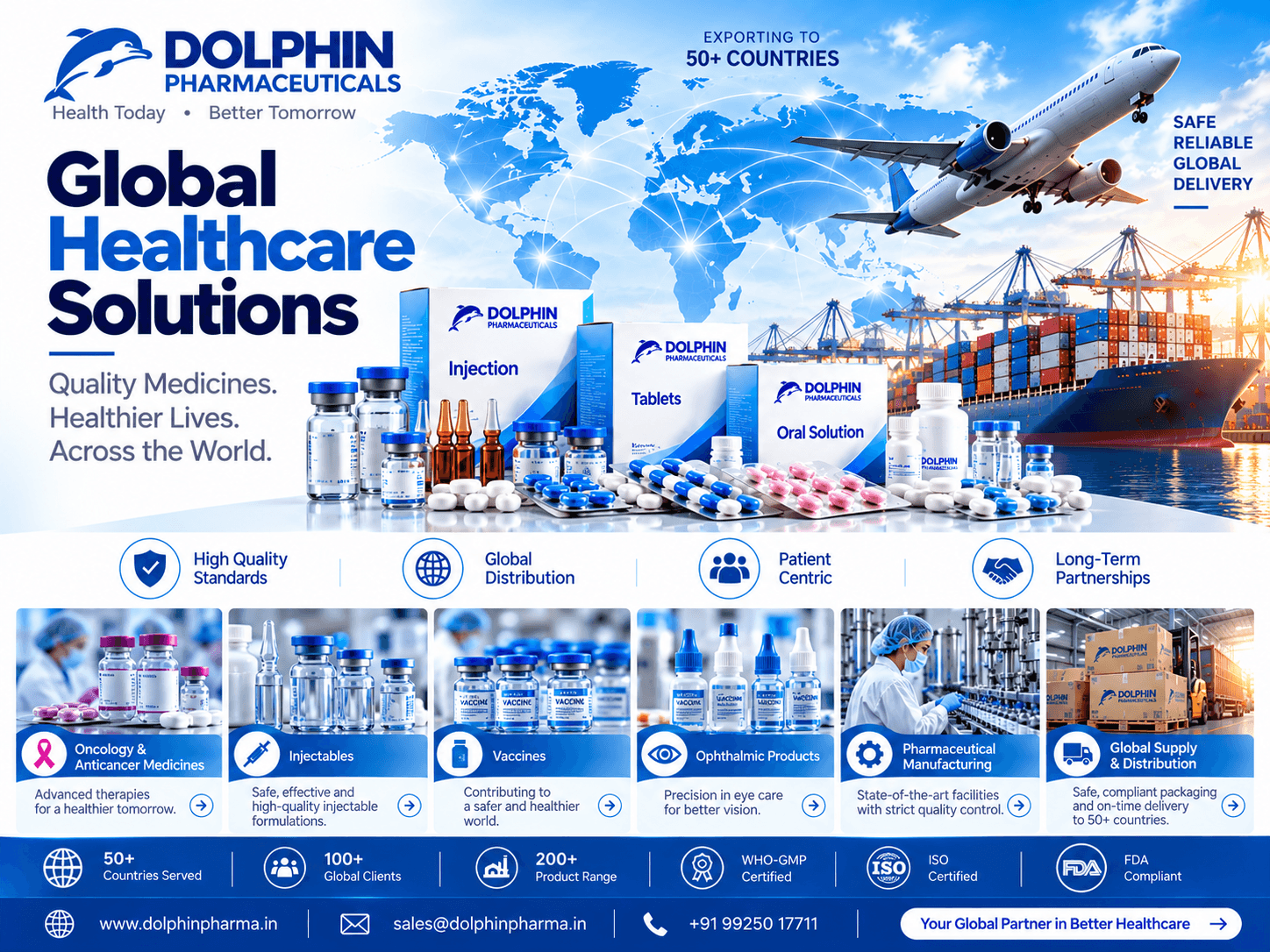
Dolphin Pharmaceuticals, operating through Dolphin Pharma, provides an online product catalogue that international buyers can review when exploring potential sourcing options. The catalogue includes medicines from different manufacturers. Product details, current availability, supporting documents, and export eligibility should be confirmed for each enquiry.
This guide explains how pharmaceutical importers can choose a suitable export partner and establish a more dependable medicine supply process.
1. Define Your Medicine Supply Requirements
Before approaching potential exporters, importers should clearly define what they need. A supplier cannot reliably fulfil an order if the product specifications, quantities, documentation, and delivery expectations remain unclear.
Start by preparing a purchasing plan that identifies the medicines required and the expected ordering frequency.
Information to prepare
- Generic name or active ingredient.
- Required strength and dosage form.
- Preferred brand, if applicable.
- Packaging and pack size.
- Expected order quantity.
- Estimated monthly or quarterly demand.
- Destination country and intended importer.
- Required remaining shelf life.
- Storage and transportation requirements.
- Applicable registration or import-authorisation details.
For regular purchasing, buyers should distinguish between confirmed demand and estimated future requirements. This helps avoid placing unnecessarily large orders or expecting a supplier to guarantee quantities that have not been confirmed.
A detailed product specification sheet also makes supplier quotations easier to compare because every prospective partner is responding to the same requirements.
2. Verify the Exporter's Identity and Business Credentials
A reliable pharmaceutical export partner should be transparent about its business identity and role in the supply chain.
Importers should establish whether a company is a manufacturer, exporter, distributor, marketing organisation, or a combination of these. A company that exports medicines may source products from third-party manufacturers, so its role should be clearly understood.
What should buyers verify?
Legal business identity: Confirm the registered company name, business address, and contact information.
Relevant authorisations: Check the licences or registrations applicable to the company's role and the products being supplied.
Manufacturer details: Request the actual manufacturer's name and the relevant manufacturing-site information.
Export experience: Ask whether the supplier has experience handling the product categories and destination markets relevant to your business.
Communication channels: Verify that product and order-related questions can be directed to appropriate representatives.
References and records: Where appropriate, request verifiable commercial references or evidence of relevant supply experience.
Do not rely solely on certificates displayed in a brochure or website. Check the issuing authority, validity, scope, and relevance to the proposed transaction.
Supplier verification should be proportionate to the product, market, and risks involved.
3. Evaluate Product Quality and Documentation
Product quality should be a central part of supplier selection. Importers need sufficient information to assess whether the proposed product and its source meet applicable quality and regulatory requirements.
The World Health Organization explains that pharmaceutical quality assurance must extend beyond manufacturing into the distribution and supply chain. Depending on the medicine and transaction, buyers may need to review:
- Product specifications.
- Manufacturer details and relevant manufacturing licences.
- Good Manufacturing Practices (GMP) evidence, where applicable.
- Certificate of Analysis for the relevant batch, where applicable.
- Product information and approved labelling.
- Stability and shelf-life information.
- Batch identification and traceability records.
- Required product registration or import documentation.
Review documents for consistency
Check the medicine's name, strength, dosage form, manufacturer, batch number, and expiry information across the relevant records.
If a document is incomplete, inconsistent, or unclear, ask for clarification before approving the shipment.
GMP documentation is important, but it does not automatically prove that every product from a company is approved for every market. Buyers must separately verify product-specific requirements and destination-country regulations.
A dependable export partner should communicate clearly about which documents are available and which additional requirements must be addressed by the importer or another party.
4. Confirm Regulatory Requirements Before Ordering
Pharmaceutical import and distribution requirements vary between countries and product categories. A medicine that is available in the exporting country may not automatically be authorised for import or sale in the destination market.
Before confirming an order, importers should determine:
- Whether the exact product is registered or otherwise authorised.
- Whether the importer holds the required licences.
- Whether an import permit or other approval is necessary.
- Which manufacturer and product documents are required.
- Whether the proposed packaging and labelling are acceptable.
- Whether any special storage, handling, or distribution conditions apply.
These checks should take place early enough to avoid preventable shipment delays.
A capable export partner can help coordinate product information and supporting documentation, but buyers remain responsible for understanding their own import obligations and obtaining the authorisations required for their transactions.
5. Assess the Supplier's Ability to Maintain Consistent Supply
A supplier may fulfil one order successfully but struggle to meet future requirements. Importers should therefore evaluate supply capability over time rather than judging performance only on the first transaction.
Consistency depends on several factors, including product availability, manufacturer arrangements, demand forecasting, production or sourcing lead times, and shipping coordination.
Questions to ask potential partners
- Is the product currently available, or must it be sourced after an order?
- What is the estimated lead time for the required quantity?
- How is availability confirmed before an order is accepted?
- How does the supplier communicate shortages or delays?
- Can the supplier provide realistic updates on repeat orders?
- What happens if the requested brand or pack size becomes unavailable?
- How are changes to product details or sourcing arrangements communicated?
Buyers should distinguish between a confirmed order and an indicative availability statement.
For repeat purchasing, it is useful to agree on a forecasting process. Sharing expected demand can help the supplier understand purchasing patterns, but forecasts should not be treated as guaranteed orders unless the parties explicitly agree to that arrangement.
Avoid relying on unsupported promises of permanent stock or guaranteed delivery. Evaluate the supplier's documented performance and willingness to communicate constraints early.
6. Compare Pricing, Lead Times, and Commercial Terms
Price is important, but the lowest quotation may not provide the best overall value.
A fair comparison should consider the total landed cost and the supplier's ability to meet the agreed specifications and delivery conditions.
Relevant costs may include:
- Product price.
- Packaging and documentation charges.
- Freight and insurance.
- Customs duties and applicable taxes.
- Customs-clearance and handling costs.
- Regulatory or inspection charges, where applicable.
- Local storage and distribution expenses.
Ask for written quotations that specify the product, strength, dosage form, pack size, quantity, currency, quotation validity, payment terms, and delivery conditions.
Clarify the commercial agreement
The purchase agreement or accepted quotation should identify:
- The exact products and quantities.
- The agreed price and payment schedule.
- The expected dispatch or delivery timeline.
- The documents to be supplied.
- Responsibilities for transport and insurance.
- The applicable delivery terms.
- Procedures for resolving discrepancies or delays.
- Conditions governing product substitutions, cancellations, and returns, where applicable.
Clear written terms help reduce misunderstandings and provide a reference point if a problem occurs.
7. Evaluate Storage, Packaging, and Transportation
Medicine quality must be protected throughout storage, handling, and distribution. Different products have different storage requirements, so the supplier and importer should confirm the correct conditions for each medicine.
Some products can be stored under specified room-temperature conditions, while others require refrigeration, protection from light, or additional handling precautions.
Before dispatch, establish:
- The storage conditions specified for the exact product.
- Whether temperature-controlled transportation is required.
- The suitability of shipping packaging.
- Expected transit times and possible delays.
- Monitoring arrangements, where necessary.
- Procedures for managing temperature excursions.
- The minimum acceptable remaining shelf life at delivery.
Importers should also confirm that their own warehouses and distribution partners can maintain the required conditions after the goods arrive.
For temperature-sensitive products, buyers should understand what records will be available to demonstrate that transport conditions were maintained.
WHO guidance on good storage and distribution practices provides a useful framework for evaluating how medicines are handled throughout the supply chain.
8. Check Traceability and Quality-Complaint Procedures
Traceability helps importers identify products and batches throughout the supply chain. It also supports inventory control and the investigation of potential quality problems.
A pharmaceutical export partner should be able to explain how batch information is recorded and communicated for the products being supplied.
Importers should maintain relevant records of:
- Supplier and manufacturer identity.
- Product name, strength, and dosage form.
- Batch or lot numbers.
- Quantities ordered and received.
- Manufacturing and expiry dates.
- Invoices and shipping documents.
- Storage information, where applicable.
- Complaints, investigations, and corrective actions.
Ask how problems are handled
Before establishing a long-term relationship, determine how the supplier handles damaged packaging, incorrect labelling, document discrepancies, suspected quality defects, and product recalls.
Agree on appropriate contact points and escalation procedures. If a quality concern arises, preserve the relevant records and follow the applicable regulatory and quality procedures.
A supplier's response to problems can be just as important as its performance when orders proceed normally.
9. Review Communication and Customer Support
Clear communication is a practical indicator of how well a supplier may manage an ongoing relationship.
Importers should assess whether the company provides accurate quotations, responds to questions, communicates realistic timelines, and shares relevant documents without unnecessary confusion.
A useful communication process includes:
- A designated contact for enquiries and orders.
- Written order confirmations.
- Clear document-submission timelines.
- Shipment updates and tracking information.
- Prompt notification of delays or changes.
- A defined route for quality-related complaints.
Buyers should also consider time-zone differences, preferred communication methods, and the level of support required for their business.
Good communication cannot replace product quality or regulatory compliance, but it helps the parties coordinate responsibilities and resolve issues more efficiently.
10. Start with a Structured Supplier Evaluation
Importers do not need to rely on informal impressions when comparing exporters. A simple supplier evaluation scorecard can help procurement teams document their decisions.
The evaluation should reflect the risk, product type, destination market, and purchasing requirements.
For higher-risk products or critical supply arrangements, buyers may need additional due diligence, quality agreements, audits, or other formal qualification steps.
11. How Dolphin Pharmaceuticals Can Support Sourcing Enquiries
Dolphin Pharmaceuticals, operating through Dolphin Pharma, provides an online product catalogue for international buyers exploring potential pharmaceutical sourcing options.
The catalogue lists products from different manufacturers, including selected oncology medicines. Individual listings provide product details and may include manufacturer and storage information. These details should be reconfirmed for the exact product and proposed order.
Buyers can begin by reviewing the Dolphin Pharmaceuticals product catalogue and contacting the company with a specific enquiry.
To make the discussion more productive, provide:
- The required generic name, strength, and dosage form.
- The preferred brand or acceptable alternatives.
- The required quantity and packaging.
- The destination country and intended importing organisation.
- Applicable registration or import-authorisation details.
- Required documentation and remaining shelf life.
- Expected delivery timing and shipping preferences.
The company can then clarify relevant product and sourcing details for the proposed enquiry.
A product catalogue is a starting point, not a guarantee of current stock, export eligibility, or delivery timing. Importers should verify these matters individually before placing an order.
12. Build a Long-Term Partnership Through Performance Reviews
Once a supplier has been approved, importers should continue monitoring performance. A successful first order does not eliminate the need for ongoing assessment.
Review each supplier periodically using measurable indicators such as:
- On-time delivery performance.
- Accuracy of documentation.
- Fulfilment of agreed quantities.
- Product and packaging conformity.
- Communication during delays.
- Resolution of complaints.
- Accuracy of invoicing and order records.
- Consistency of repeat-order performance.
Where performance falls short, document the issue and agree on appropriate corrective actions. Persistent or serious quality and regulatory concerns may require reassessment of the supplier relationship.
Periodic reviews help procurement teams distinguish between isolated problems and recurring weaknesses.
A long-term export partnership should be built on transparent expectations, documented responsibilities, and evidence of performance—not simply on familiarity or historical purchasing volume.
Frequently Asked Questions
1. How do I choose a reliable pharmaceutical export partner?
Verify the supplier's identity, identify the actual manufacturer, review product and quality documentation, confirm destination-market requirements, assess supply capability, and agree on clear commercial and shipping terms.
2. What documents should a pharmaceutical exporter provide?
Depending on the product and transaction, relevant documents may include product specifications, manufacturer information, applicable GMP evidence, batch-specific quality documents, commercial invoices, packing lists, transport records, and required regulatory documents.
3. How can importers reduce medicine supply interruptions?
Importers can improve demand forecasting, maintain appropriate inventory, establish realistic reorder points, communicate expected demand, monitor supplier performance, and identify alternative sourcing options where legally and commercially appropriate.
4. Is the lowest-priced pharmaceutical supplier always the best option?
No. Buyers should compare total landed cost alongside product documentation, quality evidence, supply capability, delivery terms, storage requirements, and communication.
5. Why is manufacturer transparency important?
It helps importers understand the source of the product, verify relevant credentials, assess documentation, and identify the parties responsible for quality and supply-related questions.
6. Can Dolphin Pharmaceuticals be contacted for international sourcing enquiries?
International buyers can review the Dolphin Pharma product catalogue and contact the company about specific sourcing requirements. Product availability, manufacturer details, documentation, and export eligibility should be confirmed for each enquiry.
Conclusion
Choosing a pharmaceutical export partner for consistent medicine supply requires a structured approach to supplier verification, product quality, regulatory compliance, inventory planning, logistics, and communication.
Importers should define their requirements clearly, verify the actual manufacturer, review relevant documentation, confirm destination-market eligibility, and establish written commercial terms before placing an order.
Consistency should then be assessed through repeat-order performance, accurate documentation, reliable communication, and effective handling of quality concerns.
For international buyers exploring pharmaceutical sourcing options from India, Dolphin Pharmaceuticals provides an online product catalogue that can serve as a starting point for product enquiries. Buyers should confirm product-specific availability, documentation, commercial terms, and regulatory requirements before finalising a transaction.
Looking for a pharmaceutical sourcing partner? Visit the Dolphin Pharmaceuticals product catalogue to explore listed products and discuss your requirements with the company.
My Company Name - Dolphin Pharmaceuticals
My Website - https://www.dolphinpharma.in/