
Introduction
Sourcing anti-cancer medicines for international markets requires careful planning, transparent supplier relationships, and an understanding of pharmaceutical import regulations. For Jamaican pharmaceutical importers, distributors, hospitals, and healthcare procurement organisations, choosing a suitable exporter from India involves more than comparing prices. Buyers must also evaluate product quality, manufacturer credentials, regulatory documentation, storage requirements, and shipment arrangements.
India is an established source of pharmaceutical products for international markets, including generic medicines and specialist healthcare products. However, the suitability of a particular medicine for export to Jamaica must be assessed individually. Product availability in India does not automatically mean that the medicine is registered or authorised for import and distribution in Jamaica.
For businesses serving Kingston, Montego Bay, Portmore, Saint Catherine, and other Jamaican communities, a structured sourcing process can help identify documentation gaps and reduce avoidable procurement delays.
Dolphin Pharmaceuticals, operating through Dolphin Pharma, provides an online pharmaceutical product catalogue that international buyers can review when exploring potential sourcing options. Its listed portfolio includes selected oncology medicines from different manufacturers. The exact product, manufacturer, availability, supporting documents, and eligibility for export to Jamaica should be confirmed before any order is finalised.
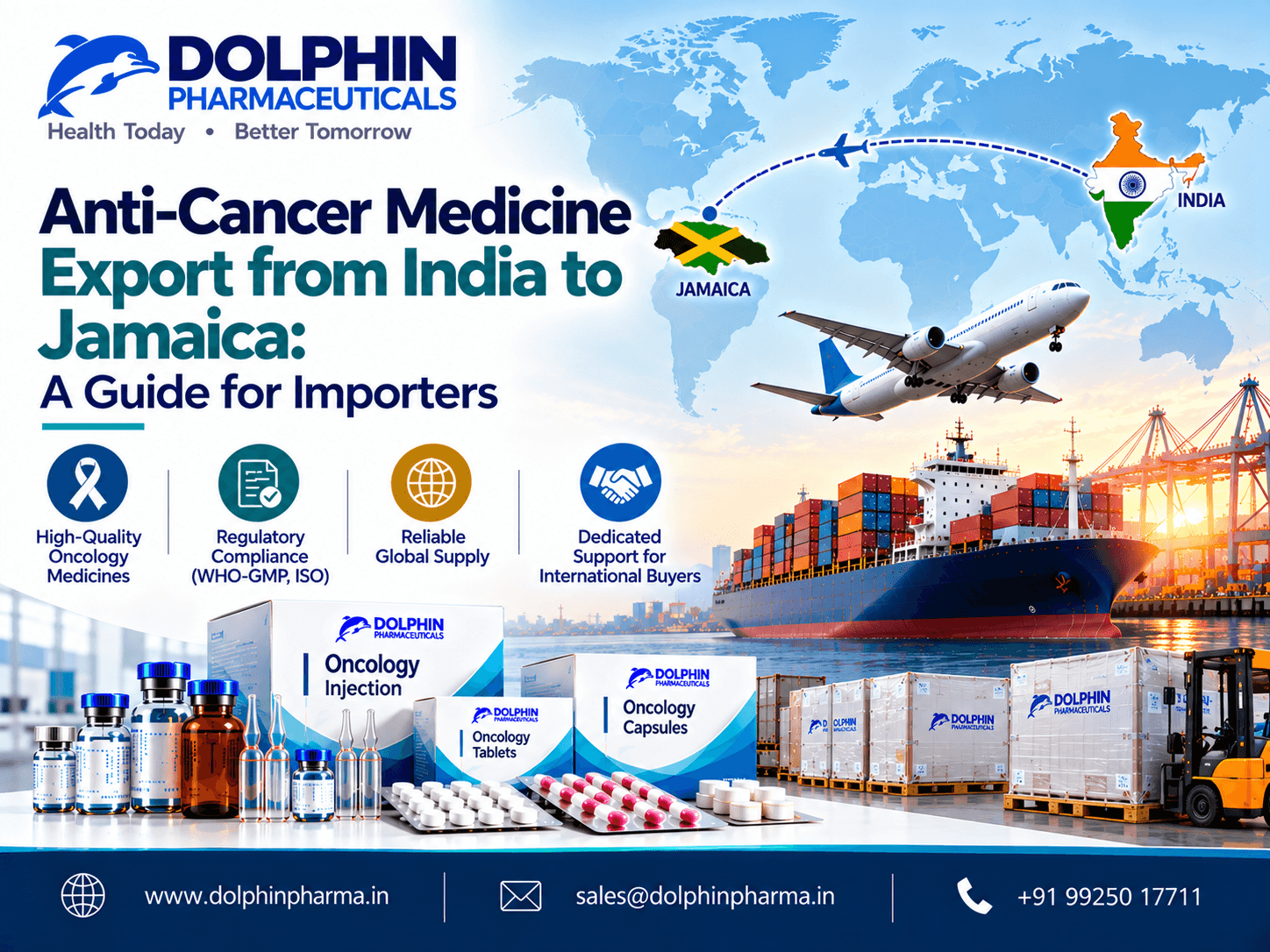
This guide explains the essential considerations for Jamaican importers looking to source anti-cancer medicines from India.
1. Understand Jamaica’s Pharmaceutical Import Requirements
Before contacting exporters or confirming an order, Jamaican importers should understand the country's pharmaceutical regulatory requirements.
The Ministry of Health and Wellness in Jamaica oversees pharmaceutical registration and import-permit processing through its Standards and Regulation Division and Pharmaceutical and Regulatory Affairs functions.
The Ministry states that most pharmaceutical products require registration before they can be imported, distributed, and sold in Jamaica. Where formal registration is not required, written approval may be necessary. Import permits are also required for regulated products under the applicable rules.
What should importers confirm?
Before placing an order, verify:
- Whether the exact medicine is registered or otherwise approved for the intended purpose in Jamaica.
- Whether the importing organisation has the required authorisation.
- Whether an import permit is required and how it must be obtained.
- Which documents must accompany the application and shipment.
- Whether the proposed manufacturer, product, strength, and dosage form meet applicable requirements.
- Whether specific labelling, packaging, or handling conditions apply.
Importers should confirm these details directly with the Jamaican Ministry of Health and Wellness or a qualified regulatory professional.
The official Standards and Regulation Division page provides information about product registration and import-permit processing.
Important: An exporter’s ability to supply a medicine from India does not establish that the product is authorised for import or sale in Jamaica.
2. Choose a Reliable Anti-Cancer Medicine Exporter from India
Selecting a suitable supplier is a critical part of international pharmaceutical procurement. Importers need a company that communicates clearly, identifies the product's source, and can explain the documents and commercial arrangements associated with a proposed order.
It is also important to distinguish between a manufacturer and an exporter. Some exporters supply products manufactured by third-party pharmaceutical companies. Buyers should understand each party’s role instead of assuming that the company providing a quotation also manufactures the medicine.
Supplier evaluation checklist
Legal identity: Confirm the supplier's business name, address, and contact details.
Manufacturer transparency: Request the actual manufacturer's name and relevant manufacturing-site information.
Quality credentials: Review applicable manufacturing licences, GMP evidence, and other relevant documentation.
Product information: Confirm the generic name, strength, dosage form, packaging, and storage conditions.
Documentation support: Ask which product-specific, batch-specific, and export documents are available.
Communication: Assess how effectively the supplier responds to questions about availability, lead time, and documentation.
Commercial terms: Request written information about pricing, payment conditions, order quantities, delivery terms, and quotation validity.
Regulatory awareness: Establish whether the supplier understands the need to verify destination-country requirements before shipment.
A professional sourcing relationship should make responsibilities clear and identify unresolved issues before the buyer commits funds.
3. Identify the Required Oncology Medicines
Anti-cancer medicines cover a broad range of products, including oral medicines, injectable treatments, targeted therapies, and other specialist pharmaceutical products. Each medicine has its own specifications, quality requirements, and regulatory considerations.
Importers should prepare a detailed product list before requesting quotations.
Examples of generic names used in oncology include:
- Capecitabine — an oral anticancer medicine used in specified treatment settings.
- Abiraterone acetate — a medicine used in certain prostate cancer treatment settings.
- Erlotinib — a targeted medicine used for particular cancers under approved indications.
- Nilotinib — a medicine used for specific types of blood cancer.
- Rituximab — a biological medicine used for certain cancers and other approved indications.
These are illustrative examples only. Their inclusion does not confirm current availability from a particular exporter or authorisation for import into Jamaica. Product selection and use must follow applicable regulatory requirements and the decisions of qualified healthcare professionals.
Prepare a clear product enquiry
A detailed enquiry should specify:
- Generic or active ingredient name.
- Required strength and dosage form.
- Preferred brand, where relevant.
- Packaging and pack size.
- Estimated quantity.
- Required remaining shelf life.
- Destination country and intended importing organisation.
- Applicable product-registration or import-authorisation information.
If the preferred brand is unavailable, buyers may ask whether other products can be considered. Any substitution must be evaluated against regulatory, procurement, and clinical requirements rather than being based on price alone.
4. Review Quality Assurance and Manufacturer Credentials
Quality assurance is a central consideration when sourcing oncology medicines for international distribution.
Importers should evaluate the actual manufacturer, relevant manufacturing site, and product-specific documentation. General statements about a supplier's quality standards are not a substitute for verifiable evidence.
Good Manufacturing Practices (GMP) establish principles and controls designed to support consistent pharmaceutical manufacturing and quality control.
Depending on the product and applicable requirements, buyers may need to review:
- Manufacturer details and relevant licences.
- GMP certificates or other accepted quality evidence.
- Product specifications.
- Certificate of Analysis for the relevant batch, where applicable.
- Product information and labelling.
- Stability and shelf-life information.
- Batch identification and traceability records.
- Documentation required for product registration or import approval.
Check documents carefully
The product name, strength, manufacturer, batch number, manufacturing date, and expiry date should be consistent wherever these details appear.
Certificates should be reviewed for validity, scope, issuing authority, and relevance to the actual manufacturing site. A certificate relating to one facility should not automatically be treated as evidence for every product associated with a company.
A Certificate of Analysis should relate to the correct product and batch. If information is missing or inconsistent, ask for clarification before proceeding.
Quality documentation helps buyers assess a proposed supply arrangement, but it does not replace Jamaica's regulatory approval and import requirements.
5. Prepare the Required Export and Import Documents
International pharmaceutical shipments may involve documents prepared by the exporter, manufacturer, importer, freight provider, and regulatory authorities.
The exact requirements depend on the medicine, the transaction, and the destination-country rules. Buyers should confirm the necessary documents before dispatch rather than relying on a generic checklist.
Documents that may be relevant include:
Commercial invoice: Records the goods, quantities, prices, and parties involved in the transaction.
Packing list: Describes the shipment's contents and packaging.
Air waybill or bill of lading: Provides transport information for the shipment.
Certificate of Analysis: Provides relevant batch test results when applicable or required.
Certificate of origin: May be required for particular customs or administrative purposes.
Manufacturer and quality documentation: May include manufacturing licences, GMP evidence, and product specifications.
Product registration or approval information: Supports the relevant regulatory process.
Import permit: Must be obtained where required under Jamaican rules.
Other documents may be required depending on the product and import route.
Agree on responsibilities early
The importer and exporter should agree in writing on who will prepare, review, submit, and retain each document. They should also confirm whether original documents, certified copies, or particular formats are necessary.
Jamaica's official Registration and Assessment Guidelines, Forms and Lists page is a useful starting point for regulatory information.
Importers should not assume that a medicine can be shipped first and its required authorisation obtained later.
6. Confirm Storage and Transportation Conditions
Pharmaceutical quality must be maintained throughout storage, transport, and distribution. Different oncology medicines have different handling requirements, so buyers should use the product-specific instructions rather than applying one storage standard to every medicine.
Some products require controlled room-temperature storage, while certain injectable or biological medicines require refrigeration or other special conditions.
Before shipment, confirm:
- The specified storage temperature and any additional handling requirements.
- Whether temperature-controlled transportation is necessary.
- The suitability of packaging for the planned route and transit time.
- Temperature-monitoring arrangements, where applicable.
- Procedures for delays or temperature excursions.
- Protection against damage and tampering.
- The minimum acceptable remaining shelf life on arrival.
For shipments from India to Jamaica, importers should consider international transit, customs clearance, and subsequent distribution within Jamaica.
Businesses serving Kingston, Montego Bay, Portmore, Saint Catherine, and other areas should also assess whether their local storage and distribution arrangements can maintain the conditions required for each product.
The buyer and supplier should agree on acceptable shelf life and shipping responsibilities before an order is confirmed.
7. Compare Prices and Total Landed Costs
Price is important, but the lowest quoted price does not necessarily represent the best sourcing arrangement.
Importers should compare the total cost of acquiring and receiving the product, including any relevant charges beyond the supplier's quoted unit price.
Potential costs include:
- Product price.
- Packaging or documentation charges.
- Freight and insurance.
- Customs duties and applicable taxes.
- Customs-clearance and handling charges.
- Regulatory or inspection fees, where applicable.
- Local storage and distribution expenses.
Request a written quotation that clearly identifies the product, strength, dosage form, packaging, quantity, currency, payment terms, quotation validity, and delivery conditions.
International commercial terms should clarify the allocation of responsibility for freight, insurance, export clearance, import clearance, and other costs.
Importers should also establish the expected lead time and identify whether it depends on product availability, regulatory approval, or document preparation.
A useful comparison considers price alongside documentation, quality evidence, storage requirements, communication, and delivery arrangements.
8. Establish a Dependable Supply Relationship
Reliable pharmaceutical sourcing involves more than completing a single transaction. Importers need clear communication and appropriate records to manage orders and address problems.
Before placing an order, establish a process for:
- Order confirmation and status updates.
- Document review and correction.
- Shipment tracking.
- Communication about delays or changes.
- Product complaints and quality concerns.
- Investigation of batch-related issues.
- Recall-related communication, where applicable.
- Recordkeeping for repeat orders.
Maintain copies of quotations, purchase orders, invoices, shipping records, and relevant quality documents. These records can support traceability and help procurement teams investigate discrepancies.
After each shipment, assess whether the supplier met the agreed terms. Review document accuracy, communication, packaging condition, shelf life, and delivery performance.
For distributors serving regulated healthcare channels, a documented and transparent supply process supports better procurement decisions and accountability.
9. How Dolphin Pharmaceuticals Can Support Sourcing Enquiries
Dolphin Pharmaceuticals, operating through Dolphin Pharma, offers a product catalogue that international buyers can review when exploring potential pharmaceutical sourcing options.
The catalogue lists selected oncology medicines and provides manufacturer and storage details on individual product listings. These details should be reconfirmed for the exact product and proposed order.
Jamaican importers can begin by reviewing the Dolphin Pharma product catalogue and submitting a product-specific enquiry.
To help clarify requirements, buyers should provide:
- The required generic name, strength, and dosage form.
- The preferred brand or acceptable alternatives.
- The desired quantity and packaging.
- The intended destination and importing organisation.
- Applicable registration or import-authorisation details.
- Required documents and minimum remaining shelf life.
- Expected delivery timing.
The supplier can then clarify the relevant sourcing details and which documents may be available for the proposed transaction.
A product listing alone does not confirm current stock, a guaranteed export route, Jamaican registration, or permission to sell the medicine locally. Each of these points must be checked individually.
10. Importer Checklist: India to Jamaica
Use this checklist to organise the sourcing process before confirming an order.
| Evaluation area | What to verify |
|---|---|
| Product eligibility | Confirm registration or other required approval in Jamaica. |
| Import authorisation | Determine the applicable import-permit process. |
| Supplier identity | Verify the supplier's legal details and role. |
| Manufacturer | Identify the actual manufacturer and relevant site. |
| Product specification | Confirm the ingredient, strength, dosage form, and pack size. |
| Quality documentation | Review relevant GMP and batch-specific records. |
| Quotation | Compare full landed cost and written commercial terms. |
| Storage and transport | Confirm requirements for the exact medicine. |
| Shelf life | Agree on minimum remaining shelf life at delivery. |
| Shipment documentation | Confirm required documents and responsible parties. |
| Receiving process | Plan inspection, recordkeeping, and escalation of quality concerns. |
Completing these checks before dispatch can help identify missing information and reduce avoidable complications.
Frequently Asked Questions
1. Can anti-cancer medicines be exported from India to Jamaica?
A transaction may be possible when the medicine, exporter, shipment, and destination requirements are satisfied. Importers must verify the product's export eligibility and meet Jamaica's applicable registration, approval, and import-permit requirements.
2. Do anti-cancer medicines require registration in Jamaica?
The Jamaican Ministry of Health and Wellness states that most pharmaceutical products require registration before importation, distribution, and sale. Certain products may be eligible for written approval instead, depending on the applicable rules. Importers should confirm the status of the exact product with the Ministry.
3. What documents should Jamaican importers request?
Depending on the product and transaction, relevant documents may include manufacturer details, GMP evidence, product specifications, batch-specific quality documentation, commercial invoices, packing lists, transport documents, and applicable import authorisation.
4. How can importers select a reliable Indian pharmaceutical exporter?
Verify the supplier's identity, identify the actual manufacturer, review relevant quality documentation, confirm regulatory eligibility, assess storage and shipping arrangements, and agree on written commercial terms.
5. Does a product appearing in a supplier's catalogue mean it is approved in Jamaica?
No. A catalogue listing does not establish Jamaican registration, import permission, current availability, or authorisation for local distribution. The status of each product must be verified separately.
6. Can Jamaican importers contact Dolphin Pharmaceuticals about oncology medicines?
Yes. International buyers can review the Dolphin Pharma product catalogue and contact the company regarding specific sourcing requirements. Product availability, manufacturer details, supporting documentation, and export eligibility should be confirmed for each enquiry.
Conclusion
Anti-cancer medicine export from India to Jamaica requires careful coordination between the exporter, manufacturer, importer, logistics providers, and relevant regulatory authorities.
For Jamaican importers, the essential steps are to verify product eligibility, assess supplier and manufacturer credentials, review quality documentation, prepare the required permits and shipping records, and confirm suitable storage and transportation arrangements.
A structured approach helps pharmaceutical distributors and procurement teams serving Kingston, Montego Bay, Portmore, Saint Catherine, and other Jamaican locations make better-informed sourcing decisions.
Dolphin Pharmaceuticals provides an online product catalogue that international buyers can use as a starting point for sourcing enquiries. Before proceeding with a transaction, importers should confirm the exact product details, available documentation, commercial terms, and Jamaican regulatory requirements.
Planning an oncology medicine sourcing enquiry? Visit the Dolphin Pharmaceuticals product catalogue to explore listed products and discuss your requirements with the company.
My Company Name - Dolphin Pharmaceuticals
My Website - https://www.dolphinpharma.in/