
Introduction
The global pharmaceutical industry depends on reliable sourcing, transparent supplier relationships, and effective distribution networks. For pharmaceutical importers, distributors, wholesalers, and healthcare procurement organisations, sourcing anti-cancer medicines internationally requires careful planning and product-specific verification.
India is an important participant in the global pharmaceutical market, supplying medicines to international markets through manufacturers, pharmaceutical suppliers, distributors, and export-oriented businesses. For global buyers, this creates opportunities to explore different pharmaceutical products, including selected anti-cancer and oncology medicines.
However, choosing an anti-cancer medicines exporter from India involves more than comparing prices. Buyers must verify the actual manufacturer, confirm product specifications, review applicable quality documentation, understand destination-country regulations, and establish realistic shipping arrangements.
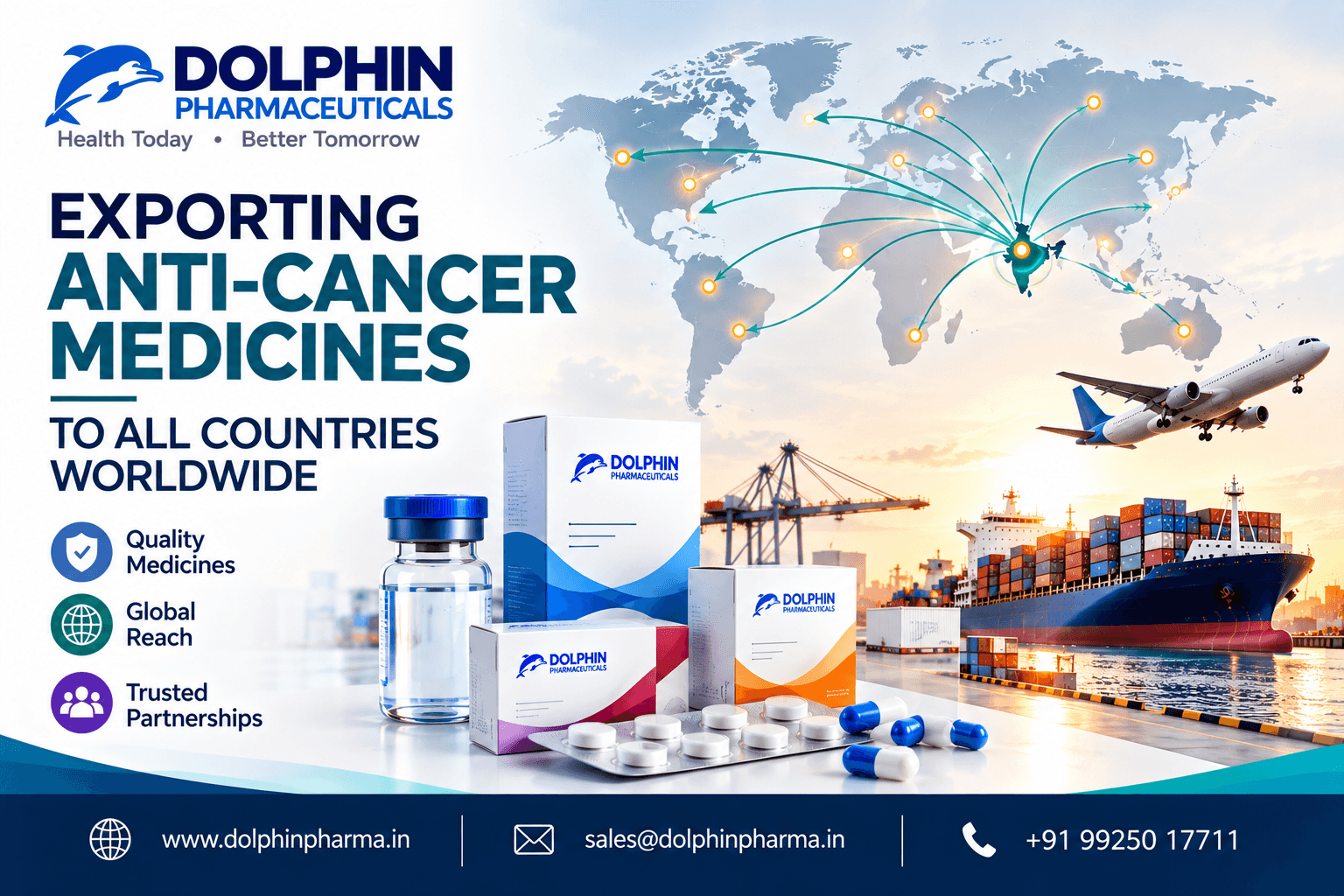
Dolphin Pharmaceuticals, based in Surat, Gujarat, India, provides a published pharmaceutical catalogue that includes selected anti-cancer and oncology products. International buyers can explore the catalogue and submit product-specific enquiries to confirm current availability, manufacturer details, documentation, and potential export arrangements.
This complete guide explains the main considerations involved in sourcing anti-cancer medicines from India and how global pharmaceutical buyers can approach the process in a structured, informed, and commercially practical way.
1. Understanding Pharmaceutical Exports from India
India has an established pharmaceutical ecosystem that includes manufacturers, finished-formulation suppliers, distributors, and exporters serving a variety of international markets.
According to India's Ministry of Commerce and Industry, pharmaceutical exports reached approximately US$30.47 billion in the 2024–25 financial year, reflecting the country's significant participation in international pharmaceutical trade.
For global buyers, India's pharmaceutical sector provides opportunities to investigate a broad range of products and sourcing arrangements. The appropriate option depends on the specific medicine, the supplier's portfolio, and the requirements of the importing country.
When evaluating a pharmaceutical export transaction, it is useful to understand the different roles involved:
- Manufacturer: Produces the medicine.
- Supplier or exporter: Offers the product or coordinates its supply and export arrangements.
- Importer or distributor: Receives the product and fulfils the applicable obligations in the destination market.
These roles may involve different companies. Importers should establish who manufactures the proposed medicine and who is responsible for documentation, shipment coordination, and other aspects of the transaction.
India's pharmaceutical capabilities offer sourcing opportunities, but they do not automatically establish that every medicine can be exported to every country.
2. Why Global Buyers Explore Indian Oncology Medicine Suppliers
International pharmaceutical buyers consider several factors when evaluating potential sourcing markets.
A broad pharmaceutical ecosystem
India has manufacturers and suppliers operating across multiple therapeutic categories. Buyers can investigate selected oncology medicines according to their product specifications and procurement requirements.
Different brands and formulations
A particular active ingredient may be offered in different brands, strengths, dosage forms, and packaging configurations. Buyers should identify the exact product required and verify that it meets their needs.
International sourcing opportunities
Export-oriented businesses can provide a point of contact for product enquiries, quotations, manufacturer information, and shipping discussions, depending on their services and business arrangements.
Potential for ongoing procurement
Transparent documentation, clear communication, and well-defined commercial terms can help importers develop more organised sourcing processes.
Nevertheless, buyers must evaluate each product individually. Availability, manufacturer arrangements, export eligibility, and local registration requirements may vary between medicines and markets.
3. Types of Anti-Cancer and Oncology Medicines
Anti-cancer medicines cover a broad range of products used in different treatment settings. From a procurement perspective, the key task is to identify the exact medicine and ensure that the proposed product meets applicable regulatory and quality requirements.
Examples of oncology-related products appearing in pharmaceutical catalogues include the following.
Capecitabine
Capecitabine is an oral anticancer medicine used in specific treatment settings. Importers should confirm the required strength, manufacturer, brand where applicable, and packaging.
Carboplatin
Carboplatin is an anticancer medicine available in injectable formulations. Buyers should verify the exact presentation and applicable storage and transportation requirements.
Cabozantinib
Cabozantinib is a targeted medicine used for certain cancer indications. Importers should identify the required strength and confirm the proposed product's manufacturer and documentation.
Lenalidomide
Lenalidomide is an oncology-related medicine used in specific treatment settings. Buyers should verify the precise product details and any applicable market-specific requirements.
Abiraterone acetate
Abiraterone acetate is used in certain prostate cancer treatment settings. Buyers should specify the required strength, brand preference, and packaging configuration.
These examples are provided for pharmaceutical sourcing context only. They do not confirm current stock, destination-market approval, or eligibility for export in a particular transaction. Product selection and use must follow applicable regulations and qualified medical guidance.
4. How to Choose an Anti-Cancer Medicines Exporter from India
Selecting a suitable exporter requires a structured evaluation of the supplier and the proposed transaction.
Verify business information
Review the supplier's official website, contact information, published portfolio, and stated role in the supply chain. Use appropriate independent verification where necessary.
Confirm the actual manufacturer
Do not assume that a supplier manufactures every medicine in its catalogue. Ask for the manufacturer's identity and verify the information through appropriate channels.
Check product specifications
Confirm the generic name, brand where applicable, strength, dosage form, packaging, and manufacturer. Ensure that the quotation and supporting documentation refer to the same product.
Review communication practices
A suitable supplier should provide clear answers about availability, specifications, documents, and commercial terms. Any unconfirmed details should be identified clearly.
Understand supply responsibilities
Clarify who is responsible for preparing documents, coordinating shipment, communicating changes, and addressing outstanding requirements.
Compare the complete commercial offer
Evaluate price, quantity, packaging, shipping, payment terms, documentation, and estimated lead time rather than relying on the quoted product price alone.
These checks help global buyers evaluate potential suppliers using consistent criteria.
5. Exploring Oncology Products Through Dolphin Pharmaceuticals
Dolphin Pharmaceuticals, based in Surat, Gujarat, India, provides an online pharmaceutical catalogue that includes an Anti-Cancer & Oncology category.
Its published catalogue includes selected oncology products, with individual listings identifying details such as product name, formulation, packaging, and manufacturer.
For international buyers, the catalogue can be a starting point for identifying products to discuss with the company.
Before proceeding with an enquiry, buyers should prepare the following information:
- Required generic name and preferred brand, where applicable
- Strength and dosage form
- Packaging requirements
- Order quantity
- Destination country
- Manufacturer preference, if any
- Required product and quality documents
- Applicable registration or import requirements
- Expected delivery schedule
Dolphin Pharmaceuticals should be contacted directly to confirm current availability, exact product details, manufacturer information, pricing, documentation, and export eligibility.
A product listing should not be treated as a guarantee of immediate stock, approval in the destination market, or confirmed delivery.
6. Product Quality and Export Documentation
Product documentation is a central part of pharmaceutical procurement. Buyers should establish which documents are required for the exact product, manufacturer, and destination market.
Depending on the transaction, relevant documentation may include:
- Product specifications and manufacturer details
- Applicable manufacturing and quality certificates
- Batch-specific quality documentation
- Certificate of analysis, where applicable
- Product registration or marketing authorisation information
- Export or import permits, where required
- Certificates or declarations requested by the importing authority
- Commercial invoice and packing list
- Relevant shipping records
The exact documentation checklist varies. Importers should consult the relevant regulatory authority or a qualified regulatory professional to establish what is required.
Documents should be checked for authenticity, consistency, and applicability to the product being supplied. A general quality statement should not replace product-specific verification.
In India, pharmaceutical exports are subject to applicable legal and regulatory requirements. Certain products or circumstances may require additional procedures or authorisations. The exporter and importer should confirm the relevant requirements before arranging shipment.
Likewise, the destination country may impose its own registration, import-permit, labelling, and distribution conditions.
7. Destination-Country Regulations and Import Eligibility
One of the most important steps in international pharmaceutical sourcing is confirming whether the requested medicine can legally be imported into the destination market.
A medicine's availability in India does not automatically mean it is registered or authorised for sale in another country.
Before placing an order, buyers should confirm:
Product registration: Does the medicine require local registration or marketing authorisation?
Importer licensing: Must the importing organisation hold a pharmaceutical import licence?
Import permits: Is a product-specific permit or other authorisation required?
Labelling and packaging: Are there particular local requirements for packaging, language, or product information?
Supporting documents: Which certificates, declarations, and product records must accompany the shipment?
Distribution requirements: Are there specific conditions for storage, distribution, or recordkeeping?
The importer should consult the relevant national medicines regulator and customs authority. The exporter and importer should agree on their respective documentation responsibilities before dispatch.
This approach helps identify potential regulatory obstacles before commercial commitments are finalised.
8. Packaging, Storage, and International Logistics
The international shipment of pharmaceutical products requires coordination between the supplier, logistics provider, and importer.
Different medicines have different storage and transportation requirements. Some products may require refrigerated transportation, while others may have different temperature limits and handling instructions.
Before dispatch, buyers should confirm:
- Storage temperature and handling instructions
- Packaging and product presentation
- Applicable shelf-life requirements
- Whether temperature-controlled transportation is necessary
- Estimated transit time
- Shipping and insurance arrangements
- Customs-clearance responsibilities
- Relevant shipment and temperature-monitoring records
For products requiring temperature control, suitable arrangements should be established before shipment. The parties should clarify how transport delays or unexpected handling issues will be managed.
Importers should also ensure that the expected delivery schedule accounts for documentation, international transit, and customs clearance.
Reliable logistics planning depends on product-specific instructions and realistic expectations rather than generic delivery promises.
9. Pricing and Procurement Planning
Competitive pricing is important for pharmaceutical importers, but the lowest quotation is not necessarily the most suitable offer.
Buyers should compare quotations using consistent product specifications, quantities, packaging, and delivery conditions.
A complete commercial review should include:
- Product cost: Confirm the exact medicine, strength, dosage form, and pack size.
- Manufacturer: Verify the proposed product's manufacturer and specifications.
- Order quantity: Clarify minimum order quantities and supply limitations.
- Documentation: Establish which documents are included and whether additional charges apply.
- Freight and insurance: Confirm shipping costs and responsibilities.
- Payment terms: Ensure the conditions are clearly documented.
- Lead time: Review preparation, dispatch, and transit estimates.
- Future orders: Discuss potential purchasing plans without assuming future stock or pricing is guaranteed.
Buyers should also consider applicable import costs and the time required to satisfy regulatory requirements.
A transparent quotation helps importers understand the complete commercial arrangement and compare suppliers more effectively.
10. Building Reliable Long-Term Supplier Relationships
Long-term pharmaceutical sourcing depends on clear expectations, accurate information, and consistent communication.
Importers can help create an organised process by providing complete product specifications, sharing destination-market requirements early, and communicating realistic quantities and timelines.
Export partners can support the process by providing clear quotations, accurate manufacturer information, updates about availability, and timely communication regarding documentation and shipment arrangements.
A productive sourcing relationship benefits from:
- Accurate product information
- Verified and applicable documentation
- Clear commercial terms
- Realistic delivery estimates
- Timely updates about changes or delays
- Defined shipping and import responsibilities
- Consistent processes for future enquiries
These practices can make repeat procurement easier to manage. Each new order should still be reviewed individually because product availability, prices, regulatory requirements, and delivery conditions can change.
Trust is best developed through verifiable information and consistent professional conduct rather than unsupported promises.
11. How to Request an Export Quotation
A detailed enquiry helps a supplier assess the requirement and identify any outstanding questions.
Step 1: Prepare a product list. Include the generic name, strength, dosage form, preferred brand, and quantity.
Step 2: Specify the destination country. This helps identify the relevant import requirements.
Step 3: Share documentation needs. Include known registration, import-permit, quality, or labelling requirements.
Step 4: Request a written quotation. Ask for the product details, manufacturer, price, availability, and estimated lead time.
Step 5: Verify supporting documents. Review the applicable product information and confirm requirements with the relevant authorities.
Step 6: Agree on logistics. Clarify packaging, storage, transport, insurance, and document responsibilities.
Step 7: Finalise the transaction. Proceed only after the product, regulatory, commercial, and shipping requirements have been reviewed.
This process helps buyers establish clear expectations before making a purchasing commitment.
Frequently Asked Questions
1. How can I find an anti-cancer medicines exporter from India?
Identify suppliers with relevant published product categories, then verify their business details, actual manufacturers, product documentation, and ability to support the proposed export transaction.
2. Does Dolphin Pharmaceuticals supply oncology medicines?
Dolphin Pharmaceuticals' published online catalogue includes selected anti-cancer and oncology products. Buyers should contact the company to confirm current availability, exact specifications, manufacturer details, documentation, and export eligibility.
3. What documents are needed to export anti-cancer medicines?
Requirements depend on the medicine and destination market. They may include product specifications, manufacturer information, quality records, registration information, permits, invoices, packing lists, and shipping documents. The exact checklist should be verified for each transaction.
4. Can all anti-cancer medicines be exported to every country?
No. Eligibility depends on the product, applicable export rules, destination-country registration, and import requirements. Each product and market must be assessed individually.
5. How can buyers evaluate the quality of an oncology medicine?
Review applicable product and manufacturer documentation, verify the relevant quality records, and confirm that the proposed medicine meets the requirements of the destination market.
6. What should I include in a pharmaceutical export enquiry?
Provide the generic name, strength, dosage form, quantity, destination country, preferred brand or manufacturer, and known documentation requirements.
7. How can I assess delivery reliability?
Ask for confirmation of product availability, estimated preparation time, dispatch arrangements, transit estimates, and customs documentation. Clarify how updates and unexpected delays will be communicated.
8. Can I enquire about bulk pharmaceutical orders?
You can submit your required products and quantities for assessment. Minimum order quantities, current availability, prices, and delivery timelines must be confirmed for each enquiry.
Conclusion: A Practical Guide to Anti-Cancer Medicines Export from India
Sourcing anti-cancer medicines internationally requires a structured approach to supplier verification, product documentation, regulatory compliance, commercial evaluation, and delivery planning.
India provides global buyers with opportunities to explore a broad pharmaceutical supply network. However, successful procurement depends on verifying the exact medicine, manufacturer, and destination-market requirements rather than assuming every product is available for every country.
Dolphin Pharmaceuticals, based in Surat, Gujarat, India, welcomes enquiries from international pharmaceutical importers, distributors, and procurement teams interested in exploring its published product portfolio, including selected oncology medicines.
Looking for an anti-cancer medicines exporter from India? Prepare your product list, required quantities, destination country, and documentation needs, then contact Dolphin Pharmaceuticals to discuss your sourcing enquiry.
Product availability, manufacturer details, pricing, export eligibility, and delivery timelines must be confirmed for each request and remain subject to applicable regulations.
My Company Name - Dolphin Pharmaceuticals
My Website - https://www.dolphinpharma.in/